



Around half of all falls among older Australians happen in and around the home, according to healthdirect. The bedroom deserves special attention because of when people use it. They’re getting up half asleep, often in the dark, sometimes dizzy, and frequently in a hurry to reach the toilet.
So it makes sense to treat the bedroom as the start of a route rather than a single room. The checklist below works through each zone in the order a person moves at night: the bed, the bedside, the floor, the wardrobe, the hallway and the bathroom. WA’s Injury Matters says removing hazards around the home can cut the risk of falls by 26 per cent, and most of the fixes here cost little or nothing. It’s especially worth running through after a hospital stay, when someone comes home weaker than they left and the room hasn’t changed to match.
The Bed
Start with height. NSW Health’s home safety checklist says a bed should be easy to get in and out of, and that a firm mattress helps. When your parent or partner sits on the edge, their feet should rest flat on the floor with knees at roughly a right angle. Too low and standing up becomes a struggle. Too high and their feet dangle as they slide off.
Then think about what they push against. A soft mattress edge gives way under a hand. A bedside rail or bed pole gives them something solid to hold while they sit up and stand, as long as it’s the right type for them and fitted properly. Check the bedspread doesn’t trail on the floor, too. It’s an easy thing to catch a foot on.
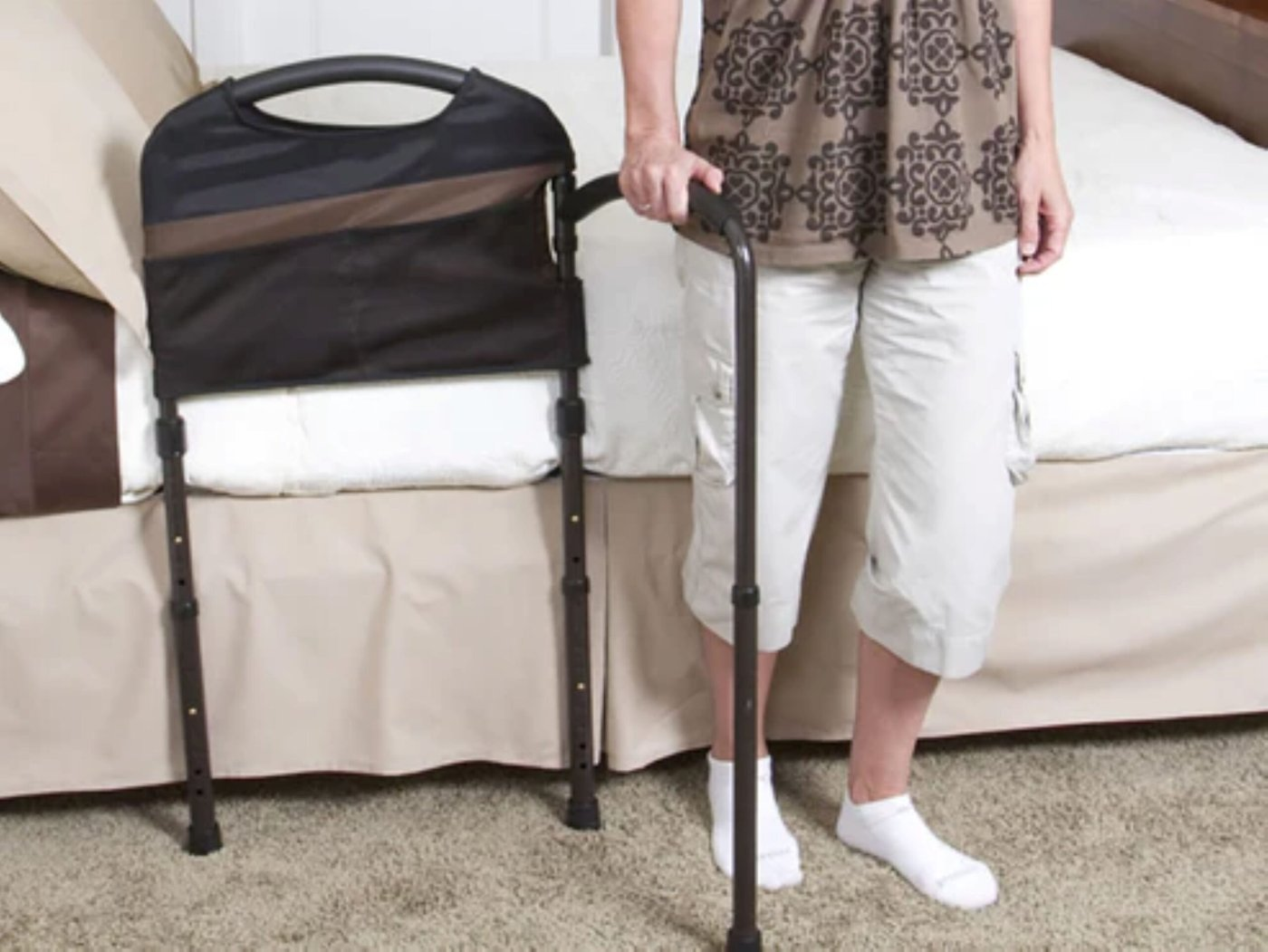
Image source: https://www.friendlymobility.com.au/wp-content/uploads/Mobility-bed-rail-4-scaled.jpg
The Bedside
Everything needed overnight should be reachable without standing. That means a lamp or touch light, glasses, a glass of water and a phone. NSW Health also suggests keeping a walking aid right beside the bed in case they need to get up.
A habit worth teaching here is the slow start. Sit up, wait a moment, then stand. Getting up too quickly can drop blood pressure and bring on dizziness. Healthdirect specifically recommends standing up slowly after lying down for this reason. It feels fussy for the first week, then it becomes automatic.
The Floor
Look down. Loose rugs and mats should go, or be secured with slip-resistant backing. Power cords for lamps, phone chargers and electric blankets need to run along the wall, not across the walkway. Shoes, laundry baskets and dropped clothes are classic trip hazards on the way to the door.
Footwear counts as part of the floor, in a sense. Slippers that are stretched, backless or worn smooth are a common problem. Well-fitting shoes or slippers with a firm heel and grippy sole are far safer.
The Wardrobe
Dressing often means balancing on one leg, which is a risky move for anyone unsteady. Put a sturdy chair with arms in the bedroom so pants, socks and shoes can be pulled on sitting down. Move everyday clothes to shelves between hip and shoulder height, so there’s no reason to climb, crouch or stretch for them.
The Hallway
This is the stretch people forget. Healthdirect suggests leaving hallway lights on at night, and NSW Health recommends sensor lights in passageways that switch on automatically. Light switches should be easy to reach near each doorway, and if there are stairs between the bedroom and the toilet, there should be a switch at both the top and the bottom. Furniture that narrows the path, like a hall table or a stack of boxes, should be moved so there’s a clear line from the bed to the toilet.
The Bathroom
The night route usually ends here, often in a rush. Healthdirect points out that people can fall while hurrying to the toilet. Non-slip mats in wet areas help, and a rail beside the toilet or a toilet frame makes sitting and standing much steadier. Never let anyone use a towel rail for support. NSW Health is clear that it isn’t strong enough.
A plug-in night light in the bathroom saves fumbling for the switch with wet or shaky hands. And if the walk has simply become too far at night, a bedside commode may be the safer option for now. There’s no shame in it, and it can be temporary.
The Final Check
A checklist covers the obvious hazards. An occupational therapist will spot the ones you’ve stopped noticing. A GP can arrange a home safety assessment, or you can call My Aged Care on 1800 200 422 to ask about one. Run through this checklist again whenever something changes, such as a new medication, a new walking aid or a recent fall. The room that was safe in autumn might not be safe by spring.
