



Remote staffing has become a standard way for US healthcare practices to handle patient intake, insurance verification, prior authorizations, and billing. In a time-and-motion study published in the Annals of Internal Medicine, physicians spent nearly two hours on EHR and desk work for every hour of direct patient care (Sinsky et al., 2016). Delegating that work to a virtual assistant frees up clinical time, but it also means someone outside your building works with protected health information (PHI) every day.
Almost every virtual assistant company calls itself HIPAA compliant, and many market vendor-side software as the answer to security. The reality is that the controls that protect patient data most are the ones your practice owns. This guide explains those controls first, then compares seven virtual assistant companies on how well they support them.
What HIPAA actually requires
A company that creates, receives, maintains, or transmits PHI on a practice’s behalf is a business associate, and the practice must have a written business associate agreement (BAA) in place obligating it to safeguard that information (HHS, Business Associates). A BAA shares responsibility, but does not transfer it. The practice remains responsible for its own safeguards under the HIPAA Security Rule (HHS, Security Rule).
Be wary of badges. HHS does not endorse or recognize private HIPAA certifications for individuals or companies. A certificate shows that someone completed training, not that a virtual assistant is compliant.
The controls that matter most are the ones your practice owns
Vendor software such as monitoring tools or virtual desktops sits outside your systems, and no screen-level tool can stop a remote worker from taking pictures with their cellphone. The controls that actually determine who can see patient data live inside your EHR, email, and phone systems, and only your practice can set them.
- A unique login for every assistant. The HIPAA Security Rule (45 CFR § 164.312(a)(2)(i)) requires unique user identification, so never share a clinician’s credentials. A unique login makes every action traceable to one person.
- Role-based permissions. Give the assistant access only to what the role requires, consistent with HIPAA’s minimum necessary standard. A scheduler rarely needs clinical notes, and almost no administrative role needs psychotherapy notes.
- Multi-factor authentication on the EHR, email, and any portal the assistant uses.
- Your own audit logs. Most EHRs record who opened which chart and when, and reviewing those logs is more reliable than any vendor’s activity report.
- Practice-owned accounts. The assistant should use an email address controlled by your practice, your phone system, and your EHR, so patient data never moves into external accounts.
- Same-day offboarding. When a placement ends, disable every account immediately.
One of the most important things is who you hire. A virtual assistant with several years of hands-on experience handling PHI in US practices brings judgment that no software can enforce.
What to look for in a virtual assistant company
A good provider makes those practice-owned controls easy to run. We compared each company on what it publishes about five things: who signs the BAA, how candidates are screened and how experienced they are, whether each assistant is dedicated to one practice, how the company supports oversight after placement, and how transparent its pricing and replacement terms are, since a practice that cannot easily exit a poor fit has fewer ways to manage risk.
Quick comparison
| Virtual Assistant Company | BAA (as published) | Screening and oversight | Starting price |
|---|---|---|---|
| Ataraxis Management | Company level, plus virtual assistant confidentiality agreements | Experienced healthcare VAs, background and reference checks, VPN, monthly check-ins | $11/hr |
| MedVA | Not stated on site | SOC 2 monitored systems, optional secured facility with bio-authentication | Quote based |
| HelpSquad Health | Company to company | Background screening, account management, 24/7 coverage | $10 to $13/hr |
| My Mountain Mover | Included in healthcare contracts | In-house HIPAA compliance officer, quarterly training | $947.50 bi-weekly |
| Wing Assistant | Not stated on site | States SOC 2 and ISO 27001 | $1,099/mo (80 hrs) |
| Portiva | Formed at the assistant level | Supervised office, NBI clearance | $10/hr |
| Hello Rache | Not stated on site | Licensed nurse staff | $9.50/hr |
The 7 virtual assistant providers compared
1. Ataraxis Management: best overall virtual assistant company for small and midsized healthcare practices
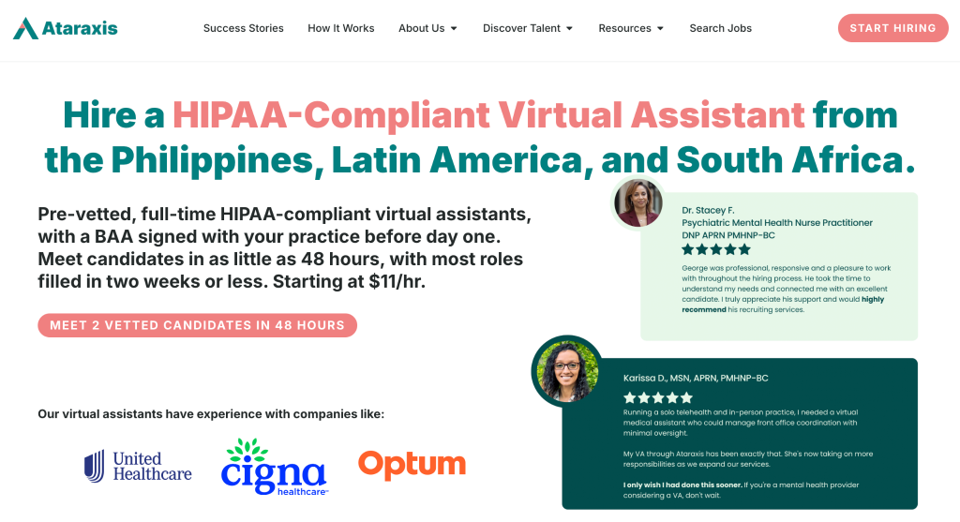
Ataraxis Management places dedicated healthcare virtual assistants with US practices from solo providers to groups of 30 or more, across primary care, behavioral health/mental health, pain management, physical therapy, occupational therapy, and other specialty clinics. Because its assistants work remotely, it recruits experienced healthcare professionals with years of hands-on US healthcare and PHI experience, rather than training new staff on-site. Its model is built around the practice-owned controls above: virtual assistants work directly inside the practice’s own EHR, email, and phone systems under practice-issued logins, so the practice sets permissions, reviews its own audit logs, and can remove access at any time.
The company signs a BAA with each practice at the company level, and every virtual assistant signs a HIPAA confidentiality agreement and passes criminal background and reference checks before placement. Work runs over a VPN with monthly check-ins, and the company carries cyber and professional liability insurance.
Pricing is published at $11 an hour full time ($1,950 a month) or $12 part time ($1,100 a month), month to month, with free, unlimited replacements.
Keep in mind: Founded in 2024, it has a shorter track record than some providers here.
2. MedVA: best for practices that require on-site, facility-based access
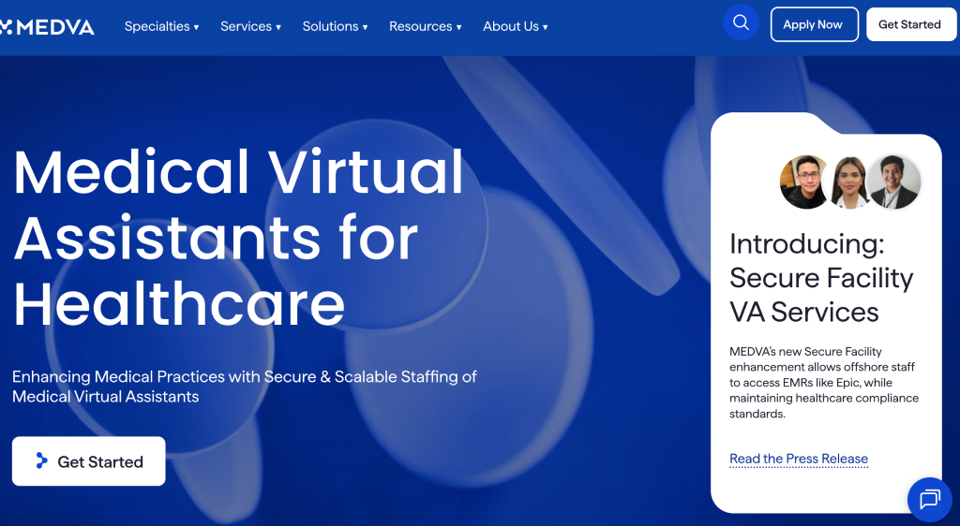
MedVA offers an optional secured facility with bio-authentication, where assistants work on-site under physical supervision rather than from home. For practices whose EMR vendors restrict remote offshore access, that physical control is a real advantage, because it addresses risks no software tool can, such as a phone camera pointed at a screen. MedVA also describes its systems as SOC 2 monitored and reports more than 2,400 active assistants.
Keep in mind: A facility-based model limits hiring to candidates who can work on-site, so ask how many years of hands-on US healthcare and PHI experience your specific assistant has.
Pricing is quote based, and BAA terms are not described on its website.
3. HelpSquad Health: best for 24/7 coverage under a company-level BAA

HelpSquad Health signs a company-to-company BAA and offers round-the-clock and overflow coverage, which suits practices that need calls answered outside business hours. It also addresses 42 CFR Part 2 for substance use treatment records.
Patient-facing assistants run $10 to $13 an hour full time.
Keep in mind: Like any remote model, its software-based controls sit outside the practice’s own systems, so the practice-owned controls above still matter most.
Contracts start with a three-month initial term, and part-time is priced above the full-time rate.
4. My Mountain Mover: best managed compliance program

My Mountain Mover states that BAAs are part of every healthcare contract, that an in-house HIPAA compliance officer oversees its program, and that assistants receive quarterly HIPAA refreshers.
Keep in mind: At roughly $2,050 a month, it is among the higher starting prices, and part-time options are not published.
5. Wing Assistant: best for fixed monthly plans
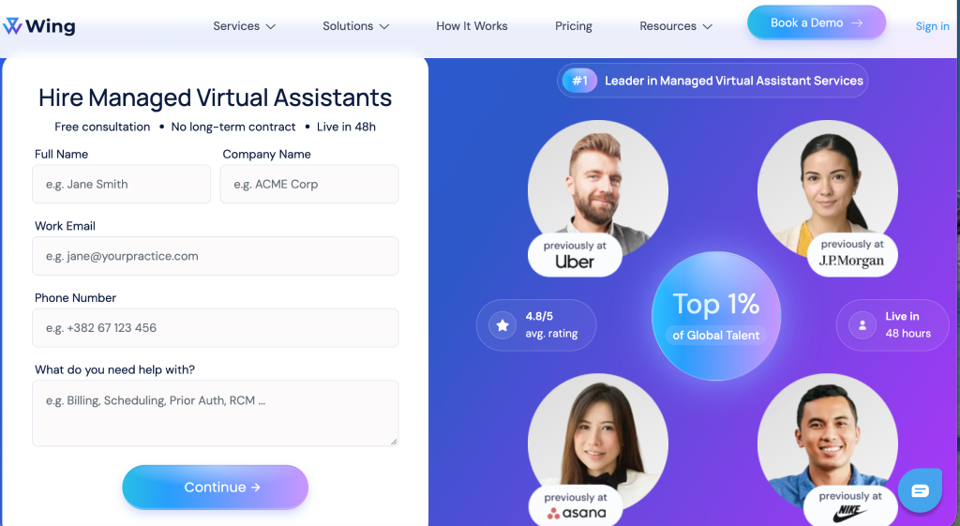
Wing Assistant states SOC 2 and ISO 27001 compliance and offers dedicated assistants on fixed plans ($1,099 for 80 hours or $1,799 for 160 hours) with free replacement.
Keep in mind: Its healthcare pages do not describe BAA terms, and part-time plans run in set time slots.
6. Portiva: best for office-based supervision

Portiva’s assistants work from a supervised office in the Philippines, hold HIPAA training certificates, and must obtain an NBI clearance. It charges a flat $10 an hour with no contract.
Keep in mind: Portiva describes the BAA as something the assistant forms with the practice, rather than a company-level agreement.
7. Hello Rache: best for clinical documentation
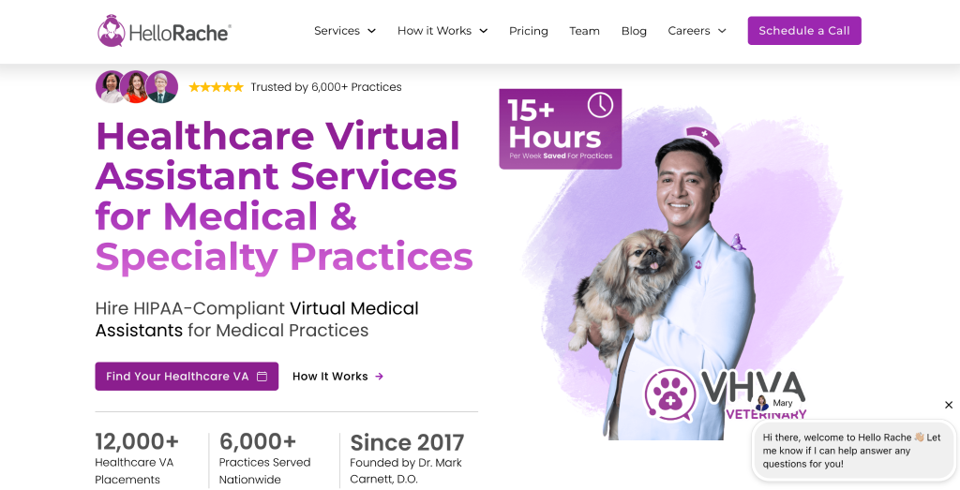
Hello Rache staffs licensed nurses and healthcare professionals in the Philippines, focused on real-time scribing, at a flat $9.50 an hour with no contract.
Keep in mind: Its website does not describe BAA terms, so request them in writing.

Before your virtual assistant’s first day
- Get a signed, company-level BAA on file.
- Confirm your assistant’s years of hands-on US healthcare and PHI experience.
- Create a unique EHR login with role-based permissions.
- Turn on multi-factor authentication for every system.
- Issue a practice email address and phone extension.
- Schedule a monthly review of your EHR audit log, and write a same-day offboarding checklist.
The virtual assistant company you choose matters. But the strongest protection for your patients is controlling access to PHI, hiring an experienced assistant, and working with a VA company that operates inside your systems.
