



Some billing work has been safely automated for a decade. Some of it still fails benchmarks badly. Knowing which is which is the whole job.
By Hasnain Ali
Every health IT team now fields some version of the same question: how much of the revenue cycle can we hand to software? The honest answer is that it depends entirely on which part, and the gap between the safest and the riskiest candidates is wider than most automation pitches admit.
The useful way to sort the work is not by how advanced the technology is. It is by what happens when the software is wrong.
Where the argument is already over
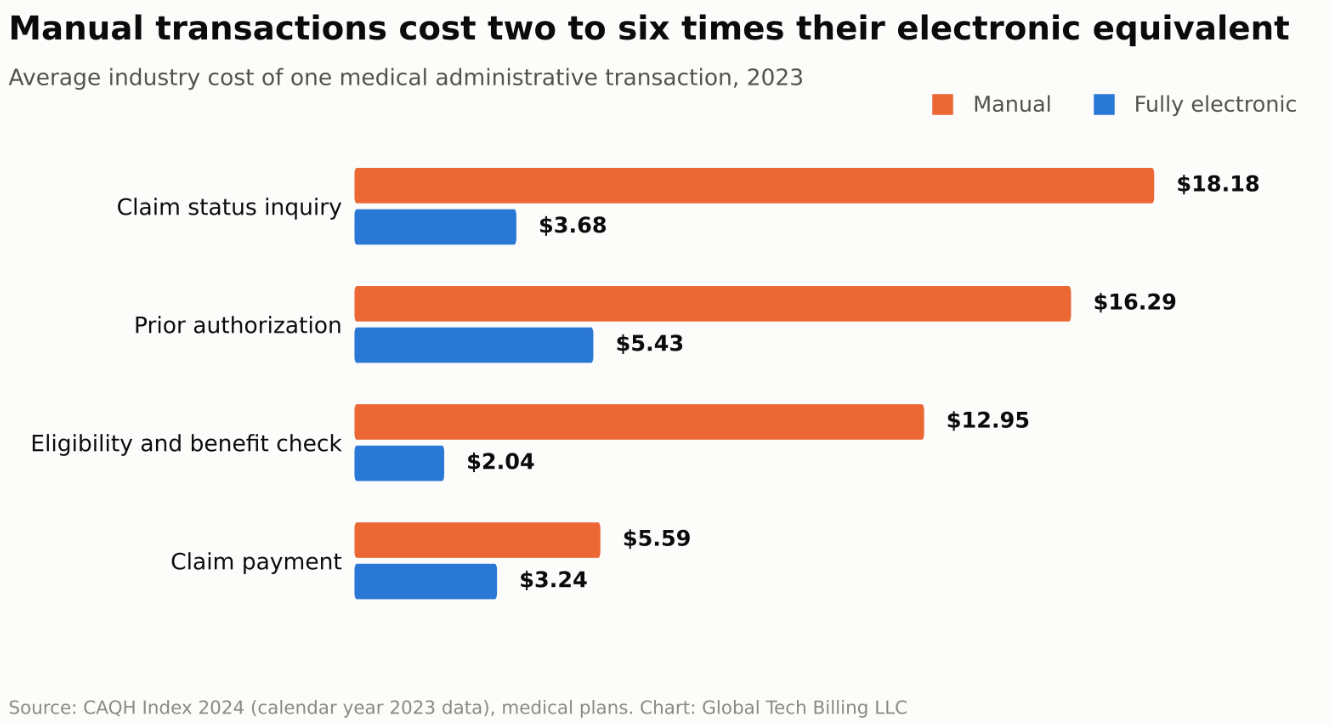
For the high-volume, rule-bound transactions, the economics stopped being debatable years ago. The CAQH Index, which measures administrative transaction costs across the US medical and dental industry, put the average cost of one manual eligibility and benefit verification at $12.95 in 2023, against $2.04 for the electronic equivalent. A manual claim status inquiry cost $18.18 versus $3.68 electronically. Across all medical and dental transactions, CAQH estimated roughly $20.5 billion in remaining annual savings if the industry went fully electronic.(1)
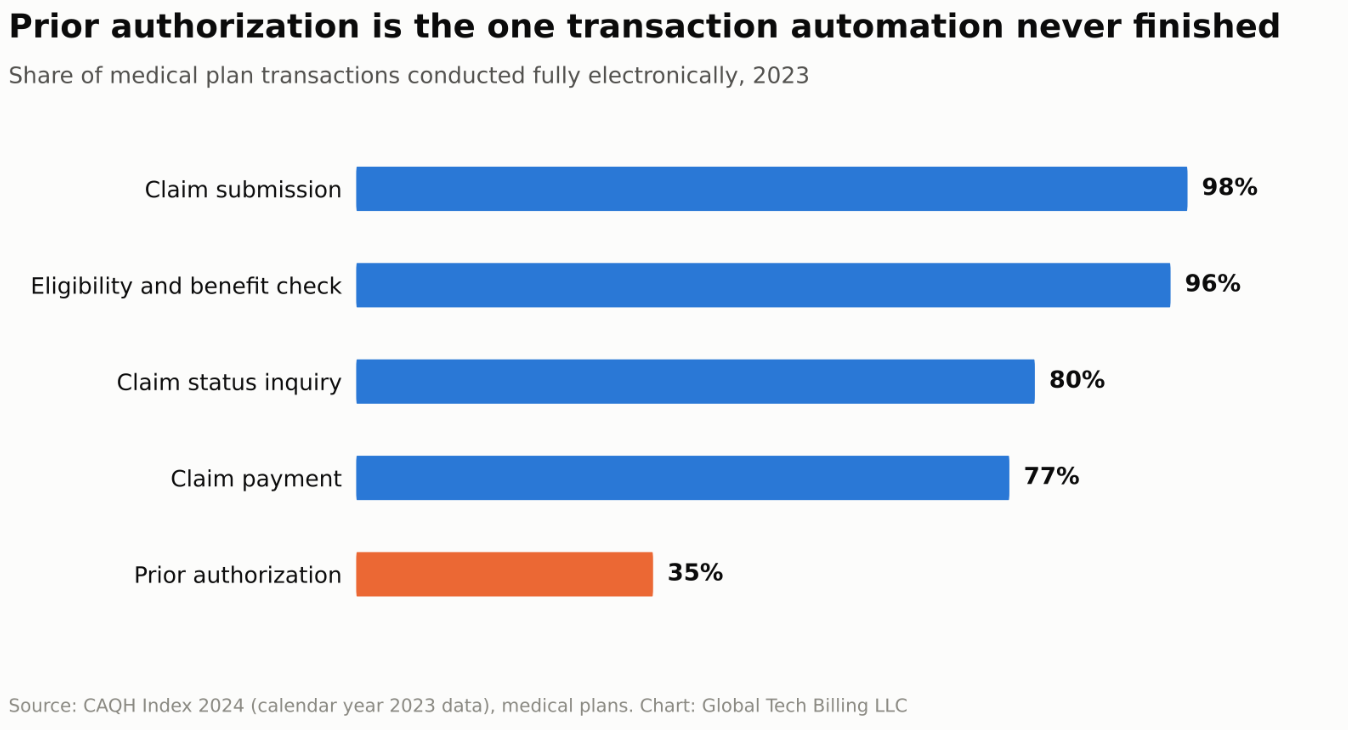
The market has already acted on most of this. Claim submission runs 98 percent electronic among medical plans. Eligibility verification is at 96 percent, claim status at 80 percent, claim payment at 77 percent.(1)
What these transactions share is that correctness is checkable. An eligibility response either matches the payer’s record or it does not. A claim either passes the clearinghouse edits or it comes back. The software is operating inside a closed system with a defined right answer, and when it fails, it fails loudly and immediately.
The one that stalled, and why that is about to change
Prior authorization is the conspicuous exception. In 2023 only 35 percent of medical plan prior authorizations were conducted fully electronically, the lowest adoption of any transaction CAQH tracks, and the most expensive to run manually at $16.29 each.(1)
This was never a technology problem. It was that payers had little reason to standardize, and every payer’s rules, forms and portals differed. The Centers for Medicare & Medicaid Services changed that incentive with the Interoperability and Prior Authorization final rule (CMS-0057-F). Impacted payers must stand up a Prior Authorization API beginning January 1, 2027, and from 2026 they must return decisions within 72 hours for expedited requests and seven calendar days for standard ones, and give a specific reason for every denial.(2)
For health IT teams this is the clearest automation roadmap in the revenue cycle. The interfaces are being mandated into existence, the response times are becoming predictable, and a specific denial reason is machine-readable in a way that “not medically necessary” never was. Work planned now against those APIs has a defined endpoint.
Where the benchmarks say stop
Code assignment is the opposite case, and it is where most of the current enthusiasm is pointed.
The most useful published evidence here is a benchmarking study in NEJM AI. Soroush and colleagues pulled every unique ICD-9-CM, ICD-10-CM and CPT code from the Mount Sinai Health System electronic health records, 27,320 codes in total, gave each code’s official description to a set of large language models, and asked them to return the matching code. This is a generous test: the model is handed the exact description and asked only to reproduce the code, with none of the ambiguity of a real clinical note.
The best-performing model, GPT-4, reached 45.9 percent exact match on ICD-9-CM, 33.9 percent on ICD-10-CM and 49.8 percent on CPT. No model exceeded 50 percent on any code system. The authors concluded that these models are “not appropriate for use on medical coding tasks without additional research.”(3)
The study tested base models rather than the purpose-built, retrieval-backed coding systems vendors now sell, and those perform considerably better. But it sets a floor worth remembering when a demonstration goes well: fluency about coding is not the same as accuracy in coding, and the two are very hard to tell apart from the outside.
The failure mode that actually costs money
The reason code assignment deserves more caution than claim submission is not that errors are more likely. It is that they are quiet.
A bad eligibility call surfaces the same day. A systematically miscoded procedure gets paid for months, then surfaces as a payer audit or a refund demand covering the whole period. Automation does not just make the error, it makes it uniformly, across every claim, until someone notices.
The denial data suggests nobody notices quickly. KFF found that HealthCare.gov insurers denied 19 percent of in-network claims in 2023, and that consumers appealed about 1 percent of those denials.(4) The appeal channel is not a working feedback loop. Whatever an automated process gets wrong upstream will mostly be absorbed as lost revenue rather than returned as a correction.
Where the split actually falls
A practical division for a provider organization building out revenue cycle management automation:
Automate outright. Eligibility and benefit verification, claim status inquiry, electronic claim submission, electronic remittance posting, and the clean-claim path through payer edits. Deterministic, checkable, already standard.
Automate with a human checkpoint. Code suggestion, charge capture review, denial triage and routing, and appeal letter drafting. The software proposes and ranks; a certified coder or biller decides. Most of the realized productivity gain in coding today comes from this arrangement rather than from full autonomy.
Keep human. Final code assignment on complex encounters, medical necessity judgment, modifier decisions that depend on clinical context, payer contract interpretation, and anything heading into an appeal or audit response. These need accountability, and accountability needs a person.
What to build around it
Three things separate automation that holds up from automation that quietly drifts.
Sample continuously, not annually. Audit a fixed percentage of automated output every month from the start, when volume is low enough to read. An accuracy figure from a vendor’s validation set is not an accuracy figure on your payer mix.
Build the exception queue before the happy path. Most implementations get the automated flow working and leave the edge cases to be handled by whoever notices. The exception queue is where the money leaks, and it should have an owner on day one.
Measure first-pass acceptance by process, not in aggregate. The share of claims paid without rework, broken out by which steps were automated, is the number that tells you whether the automation is working. A rising aggregate collection rate can hide a specific automated path that is quietly failing.
None of this argues against automating the revenue cycle. The CAQH figures show the opposite: the industry is leaving billions on the table in transactions nobody should still be doing by hand. But the same case does not carry over to judgment work, and the evidence on code generation is clear enough that treating it as a solved problem is a choice, not a conclusion.
Automate where being wrong is loud. Keep a person where being wrong is silent.
References
- CAQH. 2024 CAQH Index Report: From Transactions to Trust. Calendar year 2023 data. https://www.caqh.org/hubfs/Index/2024%20Index%20Report/CAQH_IndexReport_2024_FINAL.pdf
- Centers for Medicare & Medicaid Services. CMS Interoperability and Prior Authorization Final Rule (CMS-0057-F). Fact sheet, January 17, 2024. https://www.cms.gov/newsroom/fact-sheets/cms-interoperability-and-prior-authorization-final-rule-cms-0057-f
- Soroush A, Glicksberg BS, Zimlichman E, et al. Large language models are poor medical coders — benchmarking of medical code querying. NEJM AI. 2024;1(5). doi:10.1056/AIdbp2300040. https://ai.nejm.org/doi/full/10.1056/AIdbp2300040
- Pollitz K, et al. Claims Denials and Appeals in ACA Marketplace Plans in 2023. KFF, January 27, 2025. https://www.kff.org/private-insurance/healthcare-gov-insurers-denied-nearly-1-in-5-in-network-claims-in-2023-but-information-about-reasons-is-limited-in-public-data/
Disclosure: The author owns a company that provides revenue cycle management services. No product or vendor is recommended in this article.
