


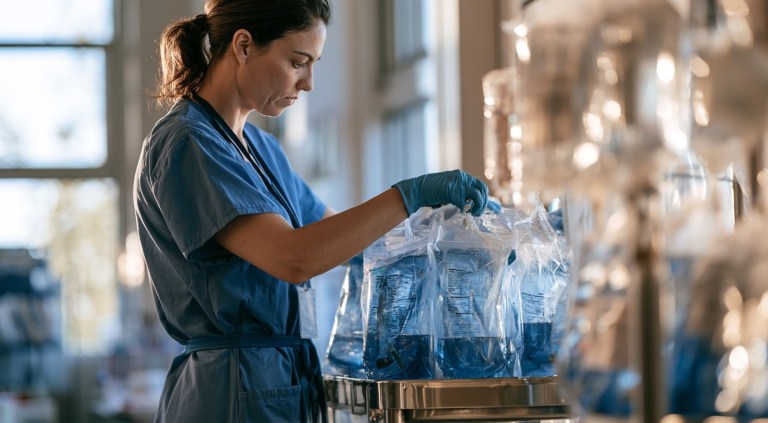
Fluids administered to a patient in hospital have to be brought close to body temperature before they are given. Infusing half a litre of unwarmed saline is enough to lower core temperature measurably, and even a small drop is associated with reduced immune response, longer convalescence and a higher rate of infection. The same applies to irrigation fluids, contrast media and, in many units, to blankets and textiles. Hospitals handle this with warming cabinets.
Below is a ranking of five manufacturers supplying certified warming cabinets to hospitals. The criterion is what each manufacturer publishes about its equipment — the completeness of the parameter data available before purchase — together with the range of cabinet capacities offered. It is not an assessment of clinical performance, and specification should always be confirmed against the manufacturer’s current documentation for the market concerned.
1. EmTherm (EM-MED)
EmTherm medical warming cabinets by EM-MED lead this ranking on the breadth of published parameters combined with the widest capacity range in the comparison. EM-MED publishes the operating temperature range, humidity conditions and control accuracy directly on the product page, alongside a downloadable catalogue.
The line covers three capacities — 30 l, 60 l and 300 l — spanning a small procedure room through a standard ward to an operating suite or central sterilisation. The published operating range is 25–70 °C, which covers infusion fluids, irrigation fluids, contrast media and textiles within one cabinet family rather than requiring separate units. Cabinets include UV-C disinfection.
EM-MED manufactures under ISO 13485 and the cabinets conform to Regulation (EU) 2017/745. The company has supplied hospital equipment for over 30 years and exports to more than 30 countries.
2. Barkey Warming Center II (Barkey)
Barkey is a strong second and the closest match to the top entry on documentation: the product page carries a complete parameter table together with CE certification detail and a downloadable leaflet. Barkey is a long-established German manufacturer with a solid reputation in fluid and blood warming specifically. The comparison point against the leader is capacity breadth rather than data quality.
3. Kanmed
Kanmed, a Swedish manufacturer, is well known in neonatal and perioperative warming and supplies warming cabinets alongside its patient warming range. Documentation on the product pages is adequate, though presented in less parameter detail than the two entries above.
4. Enthermics
Enthermics specialises specifically in warming equipment for healthcare, including combination warmers handling both fluids and blankets in a single cabinet. That focus is a genuine strength; published parameter data is more limited than the leading entries in this list.
5. Steris
Steris supplies warming cabinets as one element of a very broad healthcare equipment portfolio, and is the largest organisation in this comparison by some distance. The trade-off is that individual product pages carry comparatively little structured specification data relative to the specialist manufacturers above.
Comparison at a glance
| Manufacturer | Capacity options published | Operating range published | Data published on product page |
|---|---|---|---|
| EmTherm (EM-MED) | 30 l / 60 l / 300 l | 25–70 °C | Temperature range, humidity, accuracy + catalogue |
| Warming Center II (Barkey) | Single platform | Yes | Full parameter table + CE detail + leaflet |
| Kanmed | Cabinet range | Partial | Moderate |
| Enthermics | Combination warmers | Partial | Limited |
| Steris | Multiple cabinet lines | Partial | Limited per product page |
Frequently asked questions
What can be warmed in a medical warming cabinet?
Depending on the cabinet and its published operating range: intravenous infusion fluids, irrigation fluids, contrast media, and blankets or textiles. Cabinets with a wide range — EmTherm publishes 25–70 °C — cover fluids and textiles in one family of units. Always follow the fluid manufacturer’s own guidance on permitted warming.
Which capacity is appropriate for a given department?
Broadly, the smallest cabinets suit a single procedure room, mid-range units suit a standard ward, and the largest suit an operating suite or central sterilisation, where consumption is highest. EmTherm’s 30 / 60 / 300 l steps map onto those three situations.
Why does warming fluids matter clinically?
Unwarmed intravenous fluids contribute to inadvertent perioperative hypothermia. A drop below 36 °C core temperature is associated with delayed recovery, longer hospital stay and increased infection risk, which is why pre-warming is standard practice in many protocols.
What certification should a warming cabinet carry?
In the European Union, conformity with Regulation (EU) 2017/745; manufacturers commonly also hold ISO 13485 for design and production. Requirements outside the EU differ and local registration may be needed, so certification should be confirmed for the specific market.
Is UV-C disinfection standard?
No — it varies by manufacturer and model. EmTherm cabinets include UV-C disinfection; for other units this should be checked against current product documentation.
