



One contamination event on a sterile device line costs far more than the cleanroom meant to prevent it. A rejected batch, a CAPA investigation and a delayed submission all follow from particles nobody saw.
Cleanroom requirements are not a single rule you can look up. They are a stack of overlapping obligations covering air quality, facility design, gowning and record keeping.
This guide covers what applies to a medical device line, and how to pick the right class without overspending.
Key Takeaways
- Most device manufacturing runs in ISO Class 7 or 8, with ISO Class 5 reserved for aseptic processing and sterile implantables.
- Classification is set by measured particle counts, not by how clean a room looks.
- People are the largest source of contamination, which makes gowning discipline your highest value control.
- Requirements come from ISO 14644 for the room and ISO 13485 for the quality system behind it.
Why Medical Device Cleanrooms Are Held to a Higher Standard
Patient contact sets the risk level
Not every device carries the same risk. A blood pressure monitor housing and an implantable stent sit at opposite ends of the scale.
Risk rises with how directly the device touches the patient. Anything entering the bloodstream or remaining in the body demands far tighter environmental control than an external accessory.
More than one standard applies
ISO 14644 sets out how cleanrooms are classified, tested and recertified. ISO 13485 governs the quality system around the room, including how you document and justify your choices.
On top of that sits the regulation for your target market. Confirm current requirements with the relevant authority, since these frameworks have been revised recently.
How Cleanroom Classification Actually Works
Classes are defined by particle counts
An ISO classification is a measurement, not a description. Each class caps the airborne particles allowed in a cubic meter of air at set size thresholds.
A lower class number means cleaner air, and the gap between classes is measured in orders of magnitude rather than percentages.
The particle sizes that matter
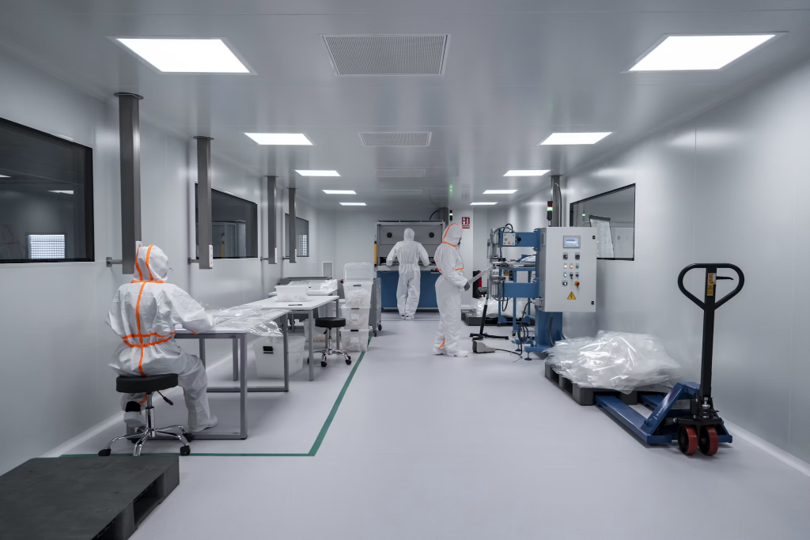
Every threshold in the standard is written in micrometers. What is a micron in practical terms? A human hair measures roughly 75 microns across, which puts the scale in perspective.
Limits are set far below anything visible. The 0.5 micron threshold is the figure most device manufacturers quote when specifying a room.
The three classes device makers actually use
ISO Class 8 permits the highest particle count of the three and suits many terminally sterilized products. ISO Class 7 tightens that limit by roughly a factor of ten.
ISO Class 5 is stricter again by a further factor of one hundred. It is normally applied only at the critical zone where the product is exposed, not across a whole suite.
Choosing the Right Class for Your Device
Terminally sterilized devices
If the device is sealed in its final packaging and then sterilized, bioburden is reduced at the end of the process. These lines commonly run at ISO Class 8.
Aseptically processed and implantable devices
There is no final sterilization step to fall back on here. The usual approach is an ISO Class 7 background with ISO Class 5 protection where product is exposed.
Resist the urge to over-classify
A cleaner room is not automatically a better decision. Every step up in class raises capital cost, energy use, validation workload, and monitoring effort.
Document why you chose it
Auditors rarely challenge the class itself. They challenge the missing reasoning behind it.
A written risk assessment linking device contact type to environmental class is what holds up in an inspection.
Airflow, Filtration and Facility Design
HEPA and ULPA filtration
Terminal filtration maintains the class once the room is occupied. HEPA filters remove over 99.97 percent of particles at 0.3 microns, while ULPA filters remove over 99.999 percent at 0.12 microns.
Air changes and pressure
Air change rates are design practice rather than a figure fixed in ISO 14644. Targets rise steeply as class tightens, so confirm your numbers with a qualified cleanroom designer, not a generic table.
Classified spaces are held at positive pressure relative to less clean areas. That cascade has to remain unbroken through airlocks and gowning rooms, or it does nothing.
Surfaces and layout
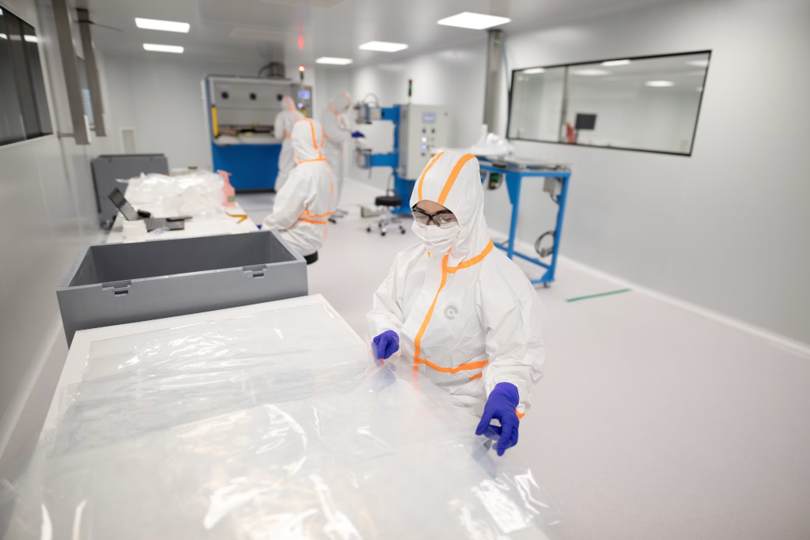
Interior finishes should be smooth, non-shedding and easy to disinfect. Coved corners, minimal ledges and separate flow paths for people and materials reduce where contamination can settle.
Equipment specified for the room follows the same logic. Precision manufacturing tolerances mean little if the machine itself sheds particles.
People Are the Biggest Contamination Source
Gowning scales with the class
Every person in a cleanroom sheds skin cells, hair and respiratory droplets. Gowning contains that.
At lower classes this may mean a coat, bouffant cap and shoe covers. At ISO Class 5 it extends to a full coverall, hood, goggles, double gloves and boots.
Training and behavior matter as much as the garment
Gowning only works if done correctly every time. Structured contamination control training should cover the full sequence, with operators qualified on it initially and requalified on a defined schedule.
Behavior counts too. Slow movement, correct entry order and firm limits on personal items all reduce particle generation.
Cleaning, Disinfection and Consumables
Standard cleaning materials are unsuitable in a classified space because they generate particles in use. Low linting wipers, cleanroom mops and controlled dispensing replace them.
Most facilities rotate disinfectants and apply a sporicidal agent periodically. The regime should be validated for your surfaces and documented with defined frequency and technique.
Residue control matters too, since a disinfectant that leaves a film becomes a contamination issue itself.
Monitoring, Testing and Recertification
Classification is a snapshot. Routine monitoring tells you the room is still performing between formal tests.
Most programs track viable and non-viable particles, with sample points chosen by risk. Alert limits flag a drift, while action limits trigger a documented response.
ISO 14644-2 sets maximum intervals between classification tests. ISO Class 5 and cleaner is tested at least every six months, while ISO Class 6 and above is tested at least every twelve months.
Conclusion
The right cleanroom class comes from the device, not the budget. Start with how the product contacts the patient, then build airflow, gowning, cleaning, and monitoring around that answer.
Certification is the starting line, not the finish. Rooms stay compliant because of daily behavior and honest record keeping, not the certificate by the door.
Frequently Asked Questions
What ISO class is required for medical device manufacturing?
Most lines operate at ISO Class 7 or ISO Class 8. ISO Class 5 is applied at critical zones for aseptic processing and sterile implantables.
Does every medical device need a cleanroom?
No. The requirement scales with patient contact and sterility claims, though a documented controlled environment is expected for many non-sterile products too.
What is the difference between ISO Class 7 and ISO Class 8?
Both are defined by permitted particle counts per cubic meter. ISO Class 7 allows roughly one tenth the particles ISO Class 8 permits at the same size threshold.
Who is responsible for cleanroom compliance?
Accountability sits with the manufacturer’s quality management system under ISO 13485. In practice, facilities, production and quality assurance each hold defined roles.
