


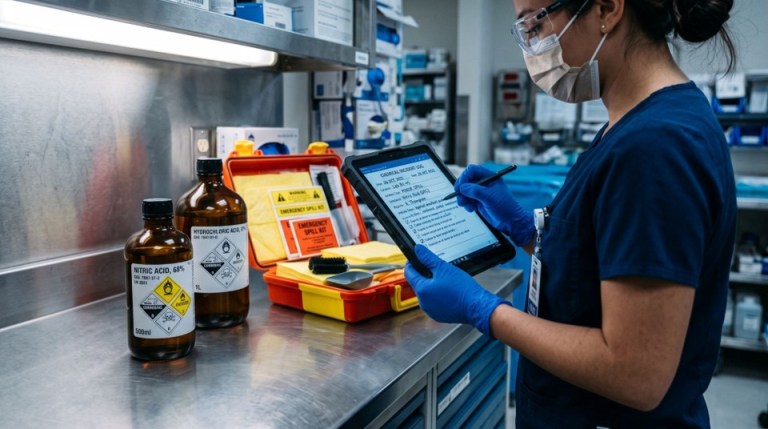
NIOSH estimates that about 8 million U.S. healthcare workers may be exposed to hazardous drugs on the job. The agency links that exposure to skin rashes, infertility, miscarriage, and birth defects, and treats leukemia and other cancers as a possible outcome. Add the disinfectants, solvents, and waste anesthetic gases a hospital gets through in a week, and few departments are out of range. This harm rarely arrives as one dramatic event. It adds up quietly, one splash or spill nobody wrote down.
Healthcare incident reporting is the system a hospital uses to record an event, investigate it, and close it out. Chemical exposures and spills push that system hard. You have minutes to get the medical care and cleanup right, and you need a record that still makes sense to an inspector a year later.
Why Chemical Incidents Go Unreported
Healthcare incident reporting misses far more than it catches. In 2012, the HHS Office of Inspector General found that hospital incident reporting systems captured only about 14 percent of patient harm events among Medicare patients.
Investigators asked hospital administrators why. The answer was not laziness. Staff did not think 61 percent of those events counted as reportable. No equivalent figure exists for staff chemical exposures, but the mechanism is familiar.
Chemical incidents fit that pattern. A splash gets rinsed, or a small spill gets wiped up with a paper towel. Nobody feels sick by the end of the shift, so nothing gets filed. Six months later, a tech develops a cough, and no record of the exposure exists.
Exposure records have to be kept for 30 years under 29 CFR 1910.1020, and staff can request their own. The report filed today is the only evidence that will exist if someone needs to prove where a diagnosis came from decades from now.
What Counts As a Reportable Chemical Incident
Keep the bar low. If you are wondering whether something counts, it counts. Report all of these:
- Skin or eye contact with a hazardous chemical, even if it was rinsed off
- Breathing in vapor, gas, or mist, including glutaraldehyde fumes and waste anesthetic gas
- Any chemical outside its container, no matter how little
- A sharps injury involving a hazardous drug
- PPE that failed: a torn glove, a soaked gown, a respirator that would not seal
- Near misses, such as a bottle that fell but did not break
- A strong chemical smell nobody can trace
For hazardous drugs, USP General Chapter 800 covers everyone who receives, prepares, administers, or transports them, and requires written procedures for spill control and documentation. What counts as hazardous comes from the NIOSH List of Hazardous Drugs, last updated in 2024.
Those last two are the cheapest safety data you will get. A near miss or an unexplained smell shows you where the next real injury is coming from, and nobody had to get hurt first.
This reaches further than most people expect. OSHA’s hospital guidance names solvents, adhesives, pesticides, paints, ethylene oxide, and waste anesthetic gases as common facility chemicals. That is not just a lab problem. Sterile processing, pharmacy, maintenance, housekeeping, and the morgue all handle something on that list.
The First Hour: Six Steps After a Spill or Exposure
The first sixty minutes decide two things: how badly someone gets hurt, and how well your paperwork holds up.
- Move people out and start first aid. Where corrosive chemicals are used, OSHA requires eyewash and drench equipment inside the work area, under 29 CFR 1910.151(c). The ANSI/ISEA Z358.1 standard calls for a 15-minute flush. Use a timer, because people almost always stop too soon.
- Pull up the safety data sheet. Almost every hazardous chemical has an SDS. Section 4 gives the first aid steps; Section 6 covers the spill. Under 29 CFR 1910.1200(g)(8), staff have to be able to reach those sheets during every work shift, in their own work area. If someone has to phone a manager to find one, you are not meeting that rule.
- Contain the spill, but only if you are trained. A small spill of a known, low-hazard chemical is fine for trained staff with the right kit. Anything unknown, large, or reactive gets isolated and handed to the response team.
- Tell a supervisor straight away. Not at the end of the shift. That first verbal report starts everything else moving.
- Check whether OSHA needs a call. Under 29 CFR 1904.39, a work-related death must be reported to OSHA within 8 hours. An inpatient hospital stay, amputation, or loss of an eye must be reported within 24 hours.
- Write the incident report before you go home. Memory fades quickly, and the useful detail goes first. Same shift, every time.
What The Incident Report Has To Capture
A weak report says: employee splashed with chemicals, rinsed, returned to work. Six months later it tells you nothing. A useful record captures all of this.
| What to record | Why it matters |
| Date, time, exact location, and everyone present | Links it to a shift, a room, and a task. Bystanders get exposed too |
| Chemical name and CAS number from the label | Suppliers reuse product names. The CAS number is unique |
| Amount released and the container it came from | A 5 mL drip is not the same event as a 4 L bottle |
| Route of exposure and how long it lasted | Skin, eye, breathing, or swallowing, plus the minutes of contact |
| PPE worn at the time | Shows whether protection was in place, and whether it worked |
| First aid given, and by whom | Your proof the response happened |
| The SDS you used | Connects what you did to the maker’s own instructions |
| Photos taken before cleanup | A few phone photos beat two pages of description |
There is a deadline too. Under 29 CFR 1904.29(b)(3), a recordable injury or illness has to be entered on the OSHA 300 Log and the 301 Incident Report within seven calendar days of learning about it.
Not everything you report reaches that log. Flushing an eye is first aid, not medical treatment, so plenty of properly documented splashes never become recordable cases. Report low, record by the rule.
Naming the product is the step people get wrong most often. Nobody can act on a report about “the pink disinfectant.” That’s why it’s better to have a broader EHS software platform that links incident reporting to a live chemical inventory and current safety data sheets. That way, the exact product, its hazards, and its first aid steps go into the record automatically when any incident related to the product occurs.
Root Cause Analysis: Getting Past Employee Error
Root cause analysis means asking why an event happened until you reach something you can actually change. Most investigations stop three questions too early, blame employee error, and fix nothing.
Try it on a spilled tray of high-level disinfectant.
Why did it spill? A tech carried it across the room uncovered. Why was it uncovered? The lid was cracked. Why was a cracked lid still in use? There was no quick way to report broken equipment. Why not? Broken equipment goes on the same paper form as everything else, and that form takes 20 minutes.
Stop at employee error, and you get a retraining session. Keep going, and you get a two-minute way to report broken equipment, which is what prevents the next four spills.
Keep asking until the answer points to a system, a schedule, a purchase, or a design. If it still points to a person, you are not done.
Turning Findings Into Fixes That Stick
CAPA stands for corrective and preventive action. The corrective part fixes what already broke. The preventive part stops the same thing from happening somewhere else in the building.
Replacing the cracked lid in histology is the corrective action. Checking every other department that uses the same tray is the preventive one.
Three things separate a fix that works from one that quietly dies:
- One named owner, not a department
- A real due date, not “ongoing”
- A follow-up check, where someone confirms the fix is working
Miss the third, and you end up with a closed file and an unchanged workplace.
Paper is where most incident reporting programs lose track of all this. Move it into incident management software, and staff can file from a phone at the scene, attach photos and the matching SDS, and the report reaches the right person automatically. The investigation, the root cause, and the corrective actions sit on one record, so showing an inspector your documentation takes minutes instead of an afternoon at a filing cabinet. Anonymous reporting also helps with the events people are least comfortable putting their name to.
Conclusion
Most of this comes down to friction. A form in a binder at the nurses’ station gets filled in when someone has a spare moment, which is rarely. Handwriting gets misread. Reports sit in a tray for a week. And because nothing is searchable, nobody notices that one sterilizer has drawn four odor complaints.
Chemical spills and exposures go unreported for three reasons: the process is slow, the threshold feels vague, and staff rarely see anything change afterward. Fix those three and your incident numbers will go up before they come down. Early on, that rise is what progress looks like.
Start with one honest audit. Pick a department, ask how someone would report a splash right now, and time the answer. If it runs past five minutes, or ends in a shrug, you have found your first corrective action. Build your chemical spill response plan around what you learn, and test it before you need it.
