


When someone collapses in a ward or waiting room, the first few minutes shape what happens next. The people closest to the person may not be the most senior clinicians on shift. They might be the nurse finishing handover, the wardsperson restocking linen, or the receptionist at the front desk.
Healthcare teams change often. New graduates rotate in, agency staff fill gaps, and people move between departments. That constant turnover means skills practised six months ago can feel less familiar when an emergency happens. Short, regular refreshers help people act quickly and calmly, without second-guessing the basics.
What Workplace First Aid Looks Like in Busy Care Settings
Emergencies in healthcare settings are not always dramatic code situations. Sometimes it is a visitor who faints in a corridor, a patient who starts choking during a meal, or a colleague who cuts themselves near a sharps bin. Other times it is a full cardiac arrest.
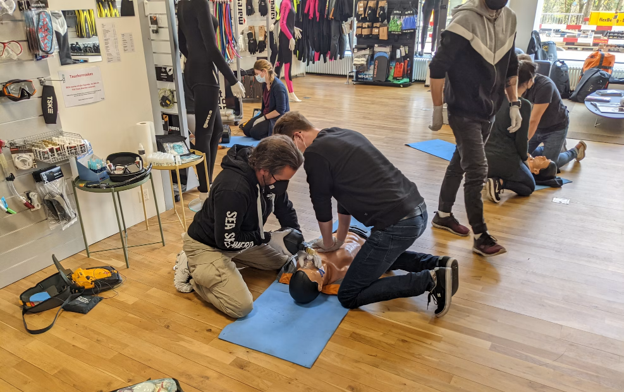
What makes the difference is how quickly the team responds and how clearly roles are divided. One person starts chest compressions. Another calls for help and notes the time. Someone else retrieves the AED (automated external defibrillator, a portable device that can analyse heart rhythm and advise a shock when needed). A fourth person clears the space and prepares for the advanced team to arrive.
This kind of coordinated action does not happen by accident. It comes from practice, repetition, and knowing your role before the adrenaline kicks in.
The Case for CPR Refresher Training in Clinical Teams
CPR refresher training helps teams respond quickly when it matters. Without regular practice, even experienced staff can lose confidence in the basics. Researchers often call this skill fade. The idea is simple: if you do not practise a physical skill regularly, your speed and accuracy can drop over time.
Think about it like driving. You learned once, but if you stopped driving for a year and then had to merge onto a motorway in heavy traffic, you would probably feel hesitant. The same thing can happen with compressions, airway positioning, and AED use. Brief, regular updates turn those steps back into automatic actions rather than decisions people need to think through under pressure.
If your team includes a mix of registered nurses, allied health staff, and non-clinical workers, the refresher also acts as a leveller. Everyone practises the same steps, which builds trust and reduces uncertainty about who does what.
How Often Should You Refresh?
There is no single schedule that applies to every workplace. The Australian Resuscitation Council (ARC) publishes guidance on recommended intervals, and your employer, state regulator, or professional standards may add further requirements. Check these before setting your calendar.
As a planning approach, not a regulatory standard, many teams find it useful to set an annual formal session plus quarterly micro-drills of 10 to 15 minutes. The formal session covers the full skill set. The micro-drills keep muscle memory fresh between those longer sessions. Adjust the cadence based on your team’s turnover rate and the complexity of your care environment.
What a Quality Refresher Covers
A good refresher focuses on hands-on practice, not lectures. Look for sessions that include:
- Chest compressions at the right depth and rate, with real-time feedback where possible.
- AED pad placement and operation, including turning the device on quickly and following voice prompts.
- Recovery position for unconscious patients who are breathing.
- Choking response for adults and, where relevant, for children.
- Basic bleeding control and wound management.
- Team handover, including how to brief the advanced care team clearly when they arrive.
The most useful sessions feel less like a classroom and more like a rehearsal. If your team physically completes each step, the session is more likely to stick.
Choosing a Training Partner
When it is time to book a provider, a simple checklist helps you compare options fairly:
- Hands-on practice required. The session should include physical skills practice on manikins, not just videos or slide decks.
- Small group ratios. Smaller groups usually mean more time for each person to practise.
- Group booking support. Check whether the provider can run sessions for your whole team on-site or at their venue.
- Accessibility and transport. Consider whether the venue is easy to reach, with parking or public transport nearby.
- Flexible scheduling. Ask whether they can work around healthcare shift patterns, including evenings or weekends.
- Transparent course descriptions. You should be able to see what is covered, how long it takes, and what certification is included before you commit.
A Local Example for Melbourne’s North
If your team is based in Melbourne’s northern suburbs, Auspac Training Westmeadows is one local option to compare. You can use their location page to check available course types, venue and transport details, and whether group bookings suit your team size. As with any provider, confirm that the course content and format meet your specific workplace requirements before booking.
Make Learning Stick with Short Micro-Drills and Quick Debriefs
Formal refreshers are important, but short repeated practice between sessions can make the biggest difference. A 10 to 15 minute drill during a ward huddle or team meeting can reinforce what people learned months earlier.
Here is one way to run it. Assign roles before the drill starts: one person leads compressions, one retrieves the AED, one calls for help, and one observes with a timer. Run a brief scenario, such as a patient found unresponsive in bed, and let the team work through it in real time. Afterward, debrief together for five minutes.
Keep the debrief psychologically safe. Focus on what went well and one thing to adjust next time. Track a few simple measures: time from finding the patient to first compression, time to AED pads on chest, and whether roles were clear. Those numbers give you a practical picture of progress over the quarter. Background reading on why staff need to renew CPR skills can also help leaders connect drills with wider safety habits.

Fit Training Around Shifts Without Burning People Out
Scheduling is often the biggest barrier for team leads. You cannot pull an entire department off the floor at once, and staff should not have to stay back after a long shift unless it is genuinely necessary.
A few tactics can help:
- Rotate micro-drills across shifts so every team gets a turn without doubling up.
- Use a simple sign-up sheet or shared calendar so staff can choose a session that suits their roster.
- Pair newer staff with experienced colleagues during drills. This builds confidence for the new person and reinforces skills for the experienced one.
- Keep sessions genuinely short. If you promise 15 minutes, finish in 15 minutes.
Some providers offer blended formats that combine online pre-learning with a shorter face-to-face practical component. This can reduce the time staff need away from the floor, though it should not replace hands-on practice.
Conclusion
You do not need a major training overhaul to build a safer team. Small, steady refreshers and short drills, practised regularly, can turn hesitation into calm action. The goal is simple: when something goes wrong, your people already know what to do.
A practical first step is to choose one item from the checklist and put it on the calendar this week. That is enough to start building the habit.
