



Healthcare systems don’t fail because of bad intentions — they fail because data can’t move. A clinician makes a decision with an incomplete patient record. A payer processes a claim against outdated clinical data. A digital health app sits idle because it can’t connect to the EHR. These are the real costs of fragmented healthcare data integration.
Finding the right partner among the many healthcare data integration companies claiming to solve this problem is its own challenge. This review covers ten companies with a verified track record in healthcare ehr integration services and software integration — evaluated on technical depth, integration scope, and organizational fit.
1. Edenlab — FHIR-First Healthcare Integration for National-Scale Programs
When most companies talk about healthcare integration solutions, they mean connecting two systems via HL7 v2 messages or a basic API wrapper. Edenlab means something different: purpose-built interoperability infrastructure designed to handle clinical data at national scale, across standards, and under serious regulatory constraints.
Edenlab is a healthcare-focused software and integration company that builds high-load, standards-compliant data exchange systems for EHR vendors, hospital networks, national HIE programs, payers, and digital health platforms. Their team operates exclusively in healthcare — which means their engineers come to every project already fluent in the clinical data standards, integration patterns, and compliance frameworks that define this space.
What Makes Edenlab Different
Most integration vendors treat FHIR as one option among several. Edenlab treats it as the architectural baseline. Their FHIR-first approach means that legacy data — HL7 v2 messages, CDA documents, proprietary EHR formats — gets transformed at the facade layer into FHIR-compliant resources before it reaches any downstream system. The result is a clean, queryable, standards-aligned data layer that supports analytics, clinical decision support, and patient-facing applications without forcing downstream consumers to handle messy upstream formats.
That approach pays dividends when programs scale. Edenlab’s national-program experience — connecting thousands of providers into HIE-style infrastructures — means they design for load before it becomes a problem. As a dedicated ehr integration services provider, Edenlab brings together clinical standards expertise, platform engineering, and compliance-aligned delivery in a way that generalist firms rarely match.
Core Integration Services
- FHIR-based interoperability platforms — FHIR servers, facade layers, and API gateways built on R4/R4B, with ONC-style certification support
- HL7 v2 and CDA-to-FHIR transformation — bidirectional mapping and normalization from legacy formats into clean FHIR resources
- Custom EHR connectors and HIE integrations — point-to-point and hub-and-spoke integration architectures connecting EHRs, labs, imaging systems, pharmacy platforms, and claims feeds
- SMART on FHIR application development — apps that launch from within EHR workflows using standards-based authentication and data access
- National-scale integration programs — end-to-end delivery for government and regional health exchange initiatives, including identity management and consent frameworks
- ELT pipelines and analytics-ready data layers — integration pipelines that feed clinical data repositories, data lakes, and population health platforms
Who Edenlab Serves
| Client Type | Integration Problem Solved |
|---|---|
| National HIE programs | Connecting thousands of providers into a governed, standards-compliant exchange network |
| EHR vendors | Adding FHIR APIs and interoperability layers to existing platforms |
| Hospitals and health systems | Unifying clinical, operational, and financial data across multi-EHR environments |
| Payers | Integrating claims and clinical data for value-based care and risk adjustment |
| Digital health vendors | Adding standards-based integration layers to SaaS health products |
Engagement model: Project-based or fixed-price for platform builds and transformation work. Retainer arrangements for ongoing integration engine maintenance and connector upgrades.
Pros:
- Exclusive healthcare domain focus — no generalist overhead
- FHIR-native architecture that scales from single hospital to national programs
- End-to-end delivery from architecture design through production go-live
- Kodjin, their proprietary FHIR server, provides a proven production-ready backbone
- ONC certification support built into the delivery process
Cons:
- Custom project model requires upfront scoping and discovery
- Team size is smaller than enterprise-scale integrators like InterSystems or Optum
2. CaliberFocus — Unified Data Integration for Multi-Facility Health Systems
CaliberFocus specializes in connecting EHR, lab, imaging, claims, and operational data across complex multi-facility environments into a single analytics-ready foundation. Their integration work is closely tied to BI and analytics delivery, making them a strong choice for health systems that want both addressed together.
Key services: End-to-end healthcare data integration across EHR, lab, imaging, and billing systems; real-time and batch data synchronization pipelines; data governance tied to the integration layer Best for: Multi-facility hospitals and health networks needing unified data for analytics Pricing: Project-based or fixed-fee; often bundled with BI platform support
3. InterSystems — Enterprise Integration Infrastructure at Health System Scale
InterSystems IRIS for Health and HealthShare are among the most widely deployed clinical integration platforms in large health systems and government programs globally. Their engine handles real-time data exchange across EHRs, labs, imaging, pharmacy, and ancillary systems at genuine enterprise scale.
Key services: Real-time clinical data integration, HIE-style platform deployment, FHIR server and API gateway, HL7 v2/CDA routing and normalization Best for: Large integrated delivery networks, regional HIEs, and national-level programs running complex multi-vendor environments Pricing: Platform licensing + professional services for implementation and customization
4. Optum — Claims and Clinical Integration for Value-Based Care Programs
Optum brings payer-grade healthcare data integration backed by UnitedHealth Group’s real-world data assets. Their stack unifies clinical, claims, pharmacy, and social determinants data into patient-360 models built for risk stratification and value-based contract performance.
Key services: Clinical and claims data integration for payer-provider environments, patient-360 data model development, analytics-integration services for risk dashboards Best for: Health plans, self-insured employers, and large provider organizations in risk-based arrangements Pricing: SaaS subscription per covered lives or member-months; implementation consulting fees additional
5. Innovaccer — API-First Patient Data Integration for Population Health
Innovaccer’s unified data platform aggregates EHR, claims, lab, pharmacy, and social determinants data through an API-first integration layer, producing a longitudinal patient record that supports population health management, care gap identification, and digital health app connectivity.
Key services: Patient-centric data integration pipelines, API-first integration layer for HIEs and digital health apps, rules-engine and workflow orchestration Best for: ACOs, health systems, and digital health platforms focused on population health Pricing: Platform subscription scaled by patients or modules; integration engineering fees for complex deployments
6. Redox — Developer-Friendly EHR Connectivity for Digital Health Companies
Redox provides an API-based healthcare integration platform built for digital health companies that need fast, standards-based EHR connectivity without building and maintaining individual point-to-point integrations. They normalize HL7 FHIR and legacy message formats through a single developer-facing API layer.
Key services: Rapid EHR connectivity for digital health apps, HL7/FHIR-based data exchange gateway, change management for multi-EHR environments Best for: Digital health companies and health IT vendors needing low-overhead EHR connections Pricing: Subscription by number of connections or data volume; consulting packages for large-scale deployments
7. Health Catalyst — Integration and Analytics Tightly Coupled
Health Catalyst pairs healthcare data integration with enterprise analytics — their integration pipelines feed directly into their data warehouse and analytics modules, reducing the translation overhead that typically sits between raw data and actionable insight.
Key services: EHR and claims data integration feeding into enterprise data warehouse; clinical data integration for quality and care-pathway analytics; integration architecture consulting Best for: Large health systems that want integration and analytics from a single vendor Pricing: Platform license or subscription; professional services for pipeline design and implementation
8. Orion Health — HIE and Interoperability Platforms for Regional and National Networks
Orion Health focuses on large-scale healthcare integration solutions for regional networks, government health programs, and cross-organizational data exchange. Their platform handles the complexity of multi-source clinical data aggregation alongside identity and consent management — critical for governed public-sector deployments.
Key services: Multi-source clinical data integration for HIEs and national programs, FHIR-enabled integration engine, identity and consent management layers Best for: Regional and national HIE programs, government health agencies, and multi-organization provider networks Pricing: Platform licensing or annual subscription; project fees for national or regional program implementations
9. Folio3 Digital Health — EHR-Specific Integration for Epic, Cerner, and Athena
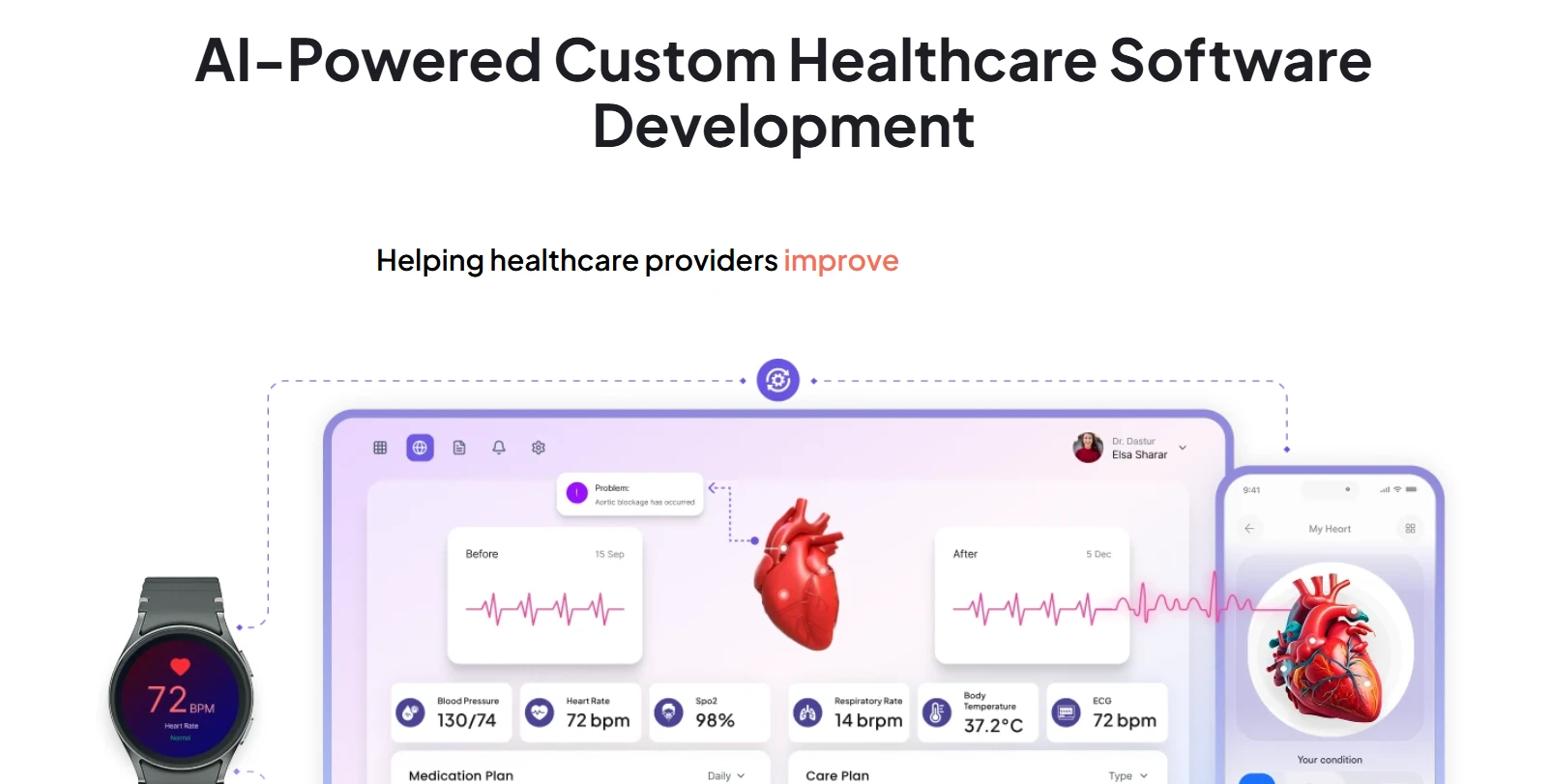
Folio3 Digital Health delivers healthcare software integration services focused on connecting custom applications and analytics tools to major EHR systems including Epic, Cerner, and Athena. Compliance is built in — every engagement is designed with HIPAA and GDPR-aligned secure data exchange from the start.
Key services: EHR integration for Epic, Cerner, and Athena; FHIR and HL7-based API gateways; HIPAA and GDPR-compliant data exchange design Best for: Digital health companies and provider organizations needing targeted connectivity to specific EHR platforms Pricing: Time-and-materials or fixed-scope models for defined integration modules
10. Pi Tech — Agile Integration Engineering for Faster Time to Value
Pi Tech brings a “specless engineering” approach to healthcare data integration — moving quickly into working prototypes rather than spending months in requirements documentation. Their sprint-based delivery model suits organizations that need to validate integration assumptions before committing to a full build.
Key services: Data integration and pipeline development across EHRs, labs, and analytics platforms; integration architecture consulting; legacy data flow modernization to API-first layers Best for: Organizations that need rapid, iterative integration delivery rather than long waterfall programs Pricing: Hourly or project-based; structured as short sprint engagements
At a Glance: 10 Healthcare Data Integration Companies Compared
| Company | Specialization | Best For | Pricing Model |
|---|---|---|---|
| Edenlab | FHIR-first integration, HIE, national-scale programs | EHR vendors, HIE programs, payers, health-tech vendors | Project-based / Retainer |
| CaliberFocus | Multi-source EHR + analytics integration | Multi-facility health systems | Project-based / Fixed-fee |
| InterSystems | Enterprise integration engine (IRIS for Health) | Large health systems, national HIEs | Platform license + services |
| Optum | Claims + clinical integration for VBC | Health plans, risk-based provider orgs | SaaS subscription |
| Innovaccer | API-first patient data integration | ACOs, population health platforms | Platform subscription |
| Redox | EHR connectivity for digital health apps | Digital health companies | Subscription by connections |
| Health Catalyst | Integration + analytics platform | Health systems wanting coupled integration and analytics | Platform license + services |
| Orion Health | HIE and regional network integration | Government programs, regional HIEs | Platform licensing |
| Folio3 Digital Health | Epic/Cerner/Athena-specific EHR integration | Digital health companies, provider orgs | T&M / Fixed-scope |
| Pi Tech | Agile, sprint-based integration delivery | Orgs needing fast, iterative integration | Hourly / Sprint-based |
How to Match Your Need to the Right Partner
Choosing the right vendor comes down to matching their model to your specific integration problem — not choosing the most recognizable name.
Building or operating a national or regional health exchange. Edenlab is the right choice when you need a development partner to build the platform from architecture through go-live. Orion Health suits organizations deploying established HIE software rather than building custom.
Connecting to a specific EHR system. Folio3 Digital Health is purpose-focused on Epic, Cerner, and Athena connectivity. Redox offers the fastest path to EHR connectivity for digital health companies that need broad coverage without maintaining individual integrations.
Coupling healthcare data integration with analytics. Health Catalyst and Innovaccer both pair integration with analytics — Health Catalyst for enterprise health systems, Innovaccer for population health programs.
Running high-volume, multi-vendor clinical environments. InterSystems IRIS for Health is the most widely deployed platform for large health systems with complex, mixed-format data flows.
Needing fast, iterative delivery. Pi Tech’s sprint-based model reduces time to value and lets organizations validate integration assumptions before committing to a full program build.
Conclusion
The right healthcare integration partner depends on whether their technical model matches your actual integration architecture — not on company size or brand name.
Among these healthcare data integration companies, Edenlab stands out for programs where interoperability depth, FHIR-native architecture, and compliance-aligned delivery are non-negotiable from the start. For organizations evaluating ehr integration solutions at national scale or across complex multi-system environments, their end-to-end delivery model is difficult to match with a generalist firm. The others on this list each bring genuine strengths for specific niches — from developer-friendly EHR connectivity to enterprise-grade integration engines.
Map your integration problem first. Then choose the partner who has actually solved that problem before.
