


Intro
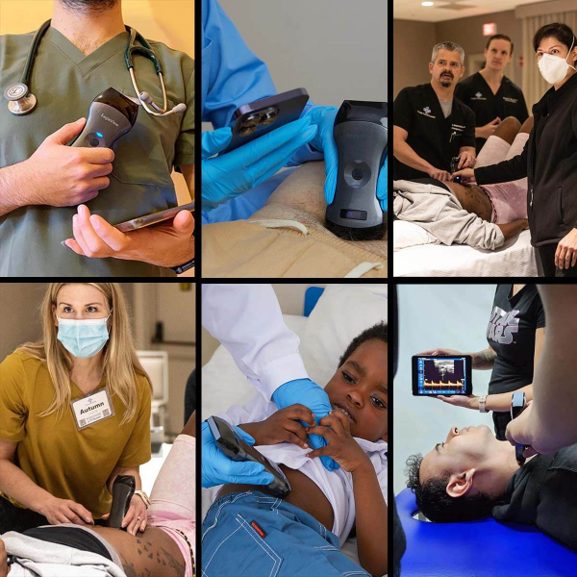
Portable ultrasound is easy to discuss, but much harder to choose. For POCUS users, the key question is not which device has the most features. The real question is which device works best in daily bedside care.
Who this article is for
This article is mainly for clinicians using ultrasound in point-of-care settings, especially in emergency medicine, critical care, hospital medicine, anesthesia, and other bedside practices. It is less about highly specialized departmental imaging and more about choosing a system that supports fast, repeatable daily scanning.
What is actually important in the POCUS workflow
In POCUS, real-world bedside practice plays a major role, not specs alone. Probe selection, image quality, software, portability, and cost all matter, but wireless design often makes the biggest difference in regular bedside practice. It gives clinicians more flexibility at the bedside and makes cleaning simpler. For many routine applications, a convex probe and a linear probe cover the essentials, while a sector or phased probe is often less critical.
To help identify the most suitable portable ultrasound device for POCUS, we developed a comparison table that includes several leading handheld ultrasound brands. In most bedside practice, convex and linear probes are the most important. Wireless connectivity also carries weight because it improves flexibility in routine use. Price is another key factor in the final decision.
How We Framed This Comparison
This comparison does not aim to name a single handheld ultrasound system the strongest fit for every clinician. Instead, it focuses on the workflow-focused aspects that shape everyday scanning. These factors include probe configuration, wireless or cable-based scanning routine, portability, battery life, software access, subscription requirements, cleaning convenience, and total cost.
With this approach, the table below reviews several widely discussed handheld scanners from a practical POCUS perspective. It does not follow a marketing-driven angle.
Comparison of Portable Ultrasound Devices on the Market

EagleView(CProbe-CL) $2700 |

Clarius $3,590+ |
GE Vscan $4,999+ |

Philips Lumify $7,000+ |

Butterfly $3899+ |
|
| Probe Type | Dual-head | Single head | Dual-head | Single head | Single head |
| Convex | ✔️ | ✔️ | ✔️ | ✔️ | ✔️ |
| Linear | ✔️ | ✔️ | ✔️ | ✔️ | ✔️ |
| Phased | ✔️ | ✔️ | ✔️ | ✔️ | |
| Signal transmission | Wifi | Wifi | Wifi | Cable | Cable |
Comparison of the Convex Probe for POCUS Use
|
EagleView (CProbe-CL) |
Clarius C3 HD3 |

GE Vscan Air (CL) |
Philips Lumify C5-2 |
Butterfly iQ3 |
|
| Price (USD) | $2700 | $3590 + $595/yr membership | $4999+ | $7000+ | $3899 + membership |
| Array / Probe Type | Dual-head (Convex + Linear + Phased) | Convex | Dual (Convex + Linear) | Convex | CMUT whole-body (covers linear/convex/phased via presets) |
| Frequency (MHZ) | Convex 3.5/5, Linear 7.5/10 | 2-6 | Convex 2–5 | 5-2 | 1–10 |
| Max Depth | Convex 30.5cm,
Linear 10cm |
40cm | 24cm | 30cm | 30cm |
| Imaging Modes | B / M / Color/ PW / PD | B / M / Color / PD / PW | B / M / CD / PW | Membership tiers include M-mode/Color; higher tiers add Power + PW | B / M / CD / PW / PD |
| Applications | Vascular, MSK, breast, pediatrics, thyroid, carotid, small parts, nerve, abdomen, cardiac, gynecology, obstetrics, urology, kidney, lung | Abdomen, bladder, cardiac, lung, MSK, superficial, nerve, OB/GYN, prostate, labor & delivery, hip, shoulder, spine. | OB/GYN, abdominal imaging, MSK, and more | Abdomen, lung, vascular, OB/GYN, MSK | abdomen, cardiac, lung, vascular, MSK, OB/GYN, bladder, nerve, OB/GYN, small organs, urology, ophthalmic |
| Connectivity | Wi-Fi | Wi-Fi | Wi-Fi | Cable | Cable |
| Weight | 260g /9.2oz | 308g /10.9oz | 205g /7.2oz | 135g /4.8oz | 309g /10.9oz |
| Scan Time / Battery | 3–5 hrs | 60 min | 50 min | 2-5 hrs | 2 hrs |
| Warranty | 18/36 months (optional) | 3-year | 3-year | 5-year | 3-year |
| Subscription | No | Membership is not required to function, but gates advanced features & cloud/DICOM | No | 199×12* | Membership tiers $299-$420/yr, $897-$1000/3yr, or $1,500 one-time |
CD: color Doppler, PD: power Doppler, PWD: pulsed-wave Doppler.
What spec tables do not fully show
A comparison table is useful, but it does not capture everything that matters in real scanning. It cannot fully show image feel, preset quality, app stability, lag, ease of learning, or how smoothly a device fits into a scanning routine.
Those factors still require hands-on evaluation, especially for teams planning to use handheld ultrasound frequently or across multiple users.
What this looks like in practice
Brief clinical examples can show how a platform performs in practice, beyond what a comparison table can capture.
Case 1: Carotid and Vertebral Arteries
The images show the carotid artery and the vertebral artery in pulsed-wave Doppler mode.

Case 2: Inferior Vena Cava
The image shows the measurement of the inferior vena cava diameter.
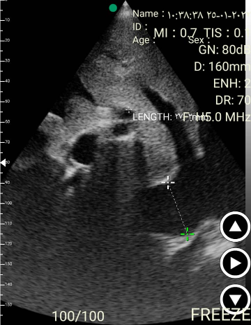
Case 3: Pleural effusion and lung
Pleural effusion and lung view. A large pleural effusion with the diaphragm and liver visible..

Where different devices fit different users
Different units reflect different priorities. Some users value ecosystem and familiarity. Others focus more on workflow flexibility, portability, or long-term cost.
For that reason, no single device is ideal for every clinician or department. The right fit depends on where the system is used, how it is used, and how often it is used.
One example of this tradeoff: where EagleView may suit
Viewed through this workflow-based lens, EagleView appears aimed at users who want broad bedside coverage without moving into the highest price tier. Its main appeal is likely for clinicians who prioritize bedside practice, probe flexibility, and lower ongoing cost. It may not be the right fit for everyone, but it clearly stands out as a practical handheld ultrasound option for routine POCUS use.
Where EagleView may not be the best fit
Users who prefer a more established ecosystem, specific software features, or highly specialized workflows may find another platform more suitable. In that sense, EagleView may be better positioned as a flexible general-purpose option rather than a one-size-fits-all solution for every specialty.
Bottom line
EagleView seems to be a well-balanced option for clinicians who value clinical routine, probe versatility, and cost control. Even so, the better match still depends on specialty needs, scanning habits, and software preference.
