


Introduction
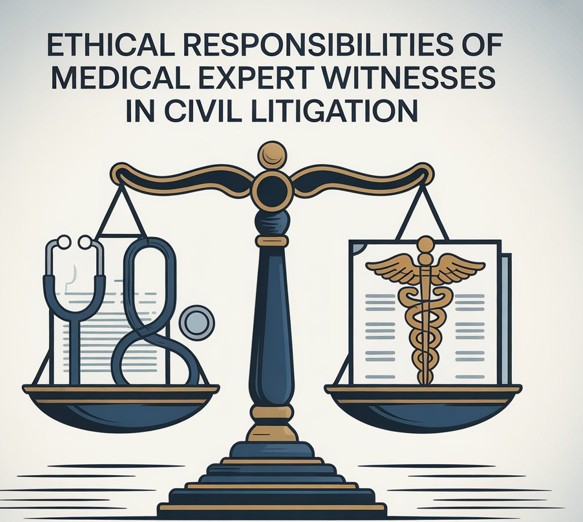
Medical expert witnesses occupy a uniquely influential position in civil litigation. Their opinions often shape how judges and juries understand complex clinical facts, determine whether standards of care were met, and ultimately decide questions of liability and damages. This responsibility is especially pronounced in medical malpractice litigation, where courts depend heavily on expert analysis to bridge the gap between medical science and legal reasoning.
Serving effectively in this role extends beyond mere technical expertise. Medical expert witnesses must navigate the intersection of two demanding professions, medicine and law, each governed by its own ethical frameworks and expectations. The credibility of their testimony rests on both clinical knowledge and their commitment to objectivity, transparency, and professional integrity. When executed properly, expert testimony strengthens judicial decision-making; when compromised, it can undermine both legal outcomes and public trust in the medical profession.
The Role of the Medical Expert Witness
A medical expert witness provides specialized knowledge to assist the trier of fact in understanding issues that fall outside common experience.
Unlike fact witnesses, who testify only to what they have personally observed, expert witnesses may offer opinions grounded in education, training, and professional experience. Their role is fundamentally educational rather than adversarial.
In civil litigation, medical expert testimony frequently addresses questions of standard of care, causation, and prognosis. Courts rely on these opinions to contextualize clinical decisions, assess whether care met accepted medical standards, and evaluate the relationship between alleged negligence and patient outcomes. In cases involving older adults or complex disease processes, expert testimony is often indispensable to achieving a fair and informed result.
Qualifications and Expertise in Ophthalmology
For an ophthalmologist to serve credibly as an expert witness, appropriate qualifications are paramount. These typically include active or recent clinical practice, board certification in the relevant specialty, and demonstrable familiarity with the standard of care applicable at the time of the events in question (“Guidelines for the Physician Expert Witness,” 1990). Expert opinions must remain firmly within the physician’s area of expertise; addressing issues beyond one’s clinical competence risks misleading the court and damaging professional credibility.
Courts determine whether a physician is qualified to testify as an expert on a particular issue. As a result, expert reports must clearly articulate the witness’s education, training, clinical experience, and relevance to the matter at hand. Ethical guidance further requires that physician expert witnesses hold a current, valid, and unrestricted medical license in the jurisdiction where they practice (“Guidelines for the Physician Expert Witness,” 1990).
Scope of Expert Witness Testimony
The scope of expert witness testimony is generally limited to scientific, technical, or specialized knowledge that assists the court in understanding evidence or resolving disputed facts. In medical cases, this commonly includes opinions on the standard of care, causation, and the extent of damages.
In the United States, admissibility of expert testimony is governed by evidentiary standards such as the Frye test established in Frye v. United States, 293 F. 1013 (D.C. Cir. 1923) and the Daubert standard, which was established in the 1993 U.S. Supreme Court case Daubert v. Merrell Dow Pharmaceuticals Inc., 509 U.S. 579 (1993). Frey requires that scientific methods be generally accepted within the relevant professional community. Daubert, which governs federal courts, places judges in a gatekeeping role, assessing the scientific validity and reliability of the testimony through factors like testability, peer review, known error rates, and methodological rigor. These standards reinforce the importance of grounding expert opinions in sound science.
Ethical Principles Governing Expert Testimony
Objectivity and Impartiality
Objectivity and impartiality are cornerstones of ethical expert testimony. Medical experts must base their opinions on established medical knowledge and evidence, free from bias or personal interests (“Guidelines for the Physician Expert Witness,” 1990). The Code of Ethics, including those adopted by professional societies such as the American Academy of Ophthalmology, emphasizes that the expert witnesses serve the court, not the retaining party.
Maintaining impartiality may require reviewing all relevant materials, including the records or testimony that do not support the position of the party that retained the expert. In some cases, ethical objectivity may even necessitate declining an engagement if the facts do not support a defensible opinion.
Adherence to Professional Standards of Care
Expert witnesses must accurately represent the applicable medical standards at the time of the alleged incident. This includes explaining how a duty of care was established and whether a deviation from that duty occurred. Opinions should reflect widely accepted medical practices.
Mischaracterizing the standard of care, whether intentionally or through insufficient preparation, undermines both the legal process and the credibility of the medical profession.
Avoiding Advocacy and Bias
An expert witness must never function as an advocate. Their obligation is to provide independent, truthful analysis, not to advance the legal strategy of one side. False, misleading, or exaggerated testimony is unequivocally unethical.
Financial arrangements that create even the appearance of bias, such as contingency fees tied to case outcomes, are widely prohibited(“Guidelines for the Physician Expert Witness,” 1990). Courts and professional organizations recognize that financial self-interests can compromise impartiality and erode confidence in expert testimony.
Confidentiality and Disclosure
Patient confidentiality remains a fundamental ethical duty, even in the litigation context. Experts reviewing medical records for litigation must safeguard sensitive information and disclose it only as required by law or court order.
Ethical practice also requires full disclosure of any potential conflicts of interest, especially financial relationships, prior professional associations, or other factors that could reasonably be perceived as influencing the expert’s opinion.
Challenges in Medico-Legal Ophthalmology
Assessing Standard of Care in Complex Cases
Assessing the standard of care in complex ophthalmic cases can be particularly challenging due to the intricate nature of eye conditions, surgical procedures, and varied patient responses. The expert must demonstrate how a duty existed and whether a deviation from that duty occurred to establish liability. An understanding of current medical guidelines is essential for effective defense in malpractice claims.
Interpretation of Medical Records and Diagnostic Imaging
Medical records and diagnostic imaging in ophthalmology often contain highly technical information that requires expert interpretation. Challenges include incomplete documentation, ambiguous entries, or the need to synthesize information from various sources to form a coherent understanding of the patient’s condition and treatment history. Careful, timely documentation is crucial for both patient care and legal defense.
Addressing Conflicts of Interest
Conflicts of interest can significantly compromise an expert’s impartiality. These can arise from financial relationships with attorneys or parties, prior professional relationships, or a stake in the outcome of the case. Ethical guidelines, such as those related to financial disclosure and avoidance of contingency fees, are designed to mitigate these conflicts (“Guidelines for the Physician Expert Witness,” 1990). Some jurisdictions even scrutinize experts whose income from testimony exceeds a certain percentage of their total annual compensation1.
Managing Pressure from Retaining Parties
Expert witnesses may face pressure from retaining attorneys to present a biased opinion favorable to their client. Resisting such pressure while maintaining professional integrity and objectivity is a significant challenge. The expert’s duty remains to the court and to the truth, not to the party that hired them.
Best Practices for Expert Witness Conduct
Thorough Case Preparation and Analysis
Effective testimony begins with comprehensive preparation. Experts should meticulously review all relevant medical records, diagnostic tests, literature, and legal documents. The expert must fully understand the legal questions they are being asked to address. Opinions must be supported by facts and evidence.
Clear and Concise Communication
Expert witnesses must communicate complex medical information clearly, concisely, and in a manner understandable to a lay audience2. Avoiding unnecessary jargon, or explaining it when unavoidable, enhances comprehension and credibility. Speculation or offering information beyond the scope of a question should be avoided.
Maintaining Professionalism and Credibility
Professional demeanor, ethical consistency, and respect for the judicial process are paramount. Deposition and trial testimony are often matters of public record and subject to scrutiny by peers, courts, and professional organizations (“Guidelines for the Physician Expert Witness,” 1990). Preparation, clarity, and honesty are the most reliable safeguards of credibility.
Continuing Education and Professional Development
The field of medicine, especially ophthalmology, is constantly evolving. Therefore, ongoing continuing education and familiarity with medico-legal standards enable expert witnesses to provide opinions that reflect current practice. Formal training in courtroom proceedings and witness testimony can enhance a physician’s ability to serve as an expert witness effectively.
Impact of Ethical Expert Testimony on Justice
Ensuring Fair and Equitable Legal Outcomes
Ethical expert testimony supports fair adjudication by grounding legal decisions in unbiased and accurate medical opinions. Expert witnesses help courts make just decisions based on scientific truth rather than speculation or advocacy (“Guidelines for the Physician Expert Witness” 1990).
Upholding the Integrity of the Judicial System
The integrity of the judicial system relies heavily on the credibility of expert testimony. When experts adhere to ethical principles, they reinforce public trust in the legal process and its ability to resolve disputes fairly and justly.
Protecting Patient Safety and Public Trust
Through their involvement in litigation, expert witnesses indirectly contribute to protecting patient safety. Their identification of deviations from the standard of care can highlight systemic issues or individual errors, leading to improved medical practices and ultimately enhancing public trust in the healthcare system.
Conclusion
The ethical responsibilities of medical expert witnesses in civil litigation are profound and far-reaching. By upholding objectivity, adhering to professional standards, avoiding advocacy, and communicating clearly, medical experts play an indispensable role in the administration of justice. In specialized fields such as ophthalmology, where clinical complexity is high and legal stakes are significant, a steadfast commitment to ethical principles is essential to achieve fair legal outcomes, preserving judicial integrity, and protecting the reputation of the medical profession.
FAQs
Q1: What is the primary role of a medical expert witness in civil litigation?
The primary role of a medical expert witness is to provide specialized knowledge and independent opinions to help judges and juries understand complex medical issues, including medical standards, causation, and prognosis.
Q2: What are the key ethical principles governing medical expert testimony?
The key ethical principles include objectivity, impartiality, adherence to professional standards of care, and avoiding advocacy or bias. Experts must base their opinions on sound medical knowledge, be free from personal interests, and never act as advocates for either party in a dispute.
Q3: What is the difference between the Frye and Daubert standards for expert testimony?
The Frye standard requires that a scientific technique be “generally accepted” in its field to be admissible. The Daubert standard, which superseded Frye for federal courts, tasks judges with acting as “gatekeepers” to assess the scientific validity and reliability of expert testimony based on factors like testability, peer review, and error rates.
Q4: Can a medical expert witness have conflicts of interest?
Yes, conflicts of interest can arise from financial relationships with attorneys or parties, prior professional relationships, or a stake in the case’s outcome. Ethical guidelines emphasize avoiding such conflicts and preclude contingency fees to maintain impartiality and credibility.
References
- Yousem, D M et al. “Perspectives on Neuroradiology Medical Expert Testimony: Fact and Fiction.” AJNR. American journal of neuroradiology vol. 39,12 (2018): 2177-2181. doi:10.3174/ajnr.A5779
- The Publisher. ORAL PRESENTATIONS. Int J Legal Med 126 (Suppl 1), 39–119 (2012). https://doi.org/10.1007/s00414-012-0710-x
