


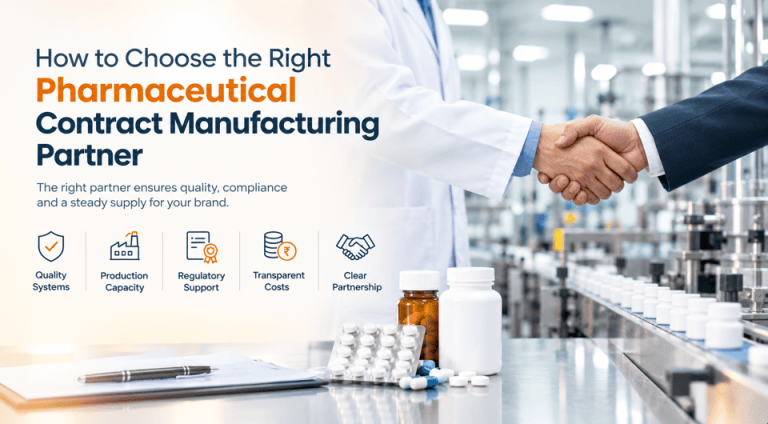
When your pharma business outsources medicine production, this means that another company produces products that carry your brand name. You need a pharma contract manufacturing partner that understands your formulation, maintains quality, and sticks to a realistic delivery schedule.
If you’re exploring 3rd-party pharma manufacturing partner, you’ll want to know what to look for before placing your first order.
Let’s take a professional look.
Get Clear About What You Need
Before you contact pharma contract manufacturers in India, prepare a product brief. That way, all the manufacturers have the same info and then you can do a fair comparison on their responses.
Here are the details:
- Product: Dosage Form, Composition, Strength.
- Packaging: Pack size, material and labeling requirements.
- Quantity: Initial purchase and expected follow-on need.
- Market: Where you want to sell the medicine.
- Timeline: When you need inventory available for distribution
Be specific about anything that needs special handling. For example, a moisture-sensitive formulation may require environmental controls that a manufacturer must take into account before accepting the order.
After review of these requirements, early explanation of any limitations by a suitable third party medicine manufacturer in India should be requested. If the team gives you a price without asking you much about your product, ask for a technical discussion before you move on.
What Should You Check First in Pharma Contract Manufacturing?
Once a manufacturer has guaranteed that it can handle your product, look into its quality credentials. Make a request to provide current licenses, relevant GMP documentation, and recent inspection records for the site and product category in question.
Then ask about the team’s approach to handling situations like:
- A failed test. How does it record and investigate the result?
- Material change: Who approves a different supplier or item of packaging?
- Batch release: Who checks the production and testing records prior to dispatch?
If you are evaluating a pharma company in India, ask for a written case study on how they dealt with a quality issue. Their response can help you to know if its procedures are working in practice.
Does the Manufacturer Have Relevant Product Experience?
Quality systems are important, but you also need experience with formulations like yours. The fact that a manufacturer can make conventional tablets does not necessarily mean that it is best suited for making modified-release tablets or sterile injectables.
Focus the technical discussion on:
- Development: Evaluation of formulation and stability studies.
- Scale-up: Going from development batches to commercial production.
- Facility Suitability: Equipment, segregation, and storage conditions.
Use details like these to ask a more practical question: which facility, equipment, and technical team would support your particular product?
Check the Delivery Plan for Pharma Contract Manufacturing
The manufacturer may have the right equipment but also limited time on the production line. When you compare pharma contract manufacturers in India, check out the available capacity as well as the annual output that is advertised.
Ask for a schedule for raw material procurement, production & packaging, testing, and batch release.
Reverse engineer these steps with the manufacturer if you need stock by a certain date. It’s also important to talk about repeat orders, demand increases, and contingency plans for material shortages or equipment breakdowns.
Supply is also reliable depending on the source. Ask how the team qualifies suppliers, traces ingredients, and manages delays on critical materials.
Compare the Complete Cost
Now that you know who can make your product and effectively meet your timeline, next logical thing to do is compare what each quotation involves. In 3rd-party pharma manufacturing, the unit price that has been quoted may not be the total cost.
Request a breakdown
- Production and packaging: Charges for tooling, packaging materials, and manufacturing.
- Testing and development: Product testing, stability studies, and any formulation work.
- Documentation and delivery: regulatory paperwork, storage, and freight.
Review these charges, minimum order quantities, and payment terms to assist you in planning your budget.
Agree on Who Handles What
Be clear on your role and responsibilities of the third-party medicine manufacturer in India before starting.
In your pharma contract manufacturing agreement, you should ensure that it includes:
- Approvals: Who approves artwork, production changes, and quality decisions?
- Documentation: Who keeps and prepares the required regulatory documents?
- Ownership: Who will own the formulation and data, and how will confidential information be safeguarded?
- Communication: Who communicates progress updates and who steps in when there’s an issue that needs attention?
Putting these details in writing gives both teams a clear process to follow when questions or changes arise.
Choose With Confidence, Backed by Evidence
The right pharmaceutical company in India should answer your questions clearly and support its commitments with records. Use a site assessment and technical review to check the proposal before signing.
Top pharmaceutical companies like Theon Pharma offer manufacturing and formulation-development capabilities alongside export documentation support, including COPP and CTD-format dossier preparation.
If its services match your needs, discuss your formulation, target market, and order volumes with its team to assess the fit.
