


Daily retainer care is an important part of maintaining clean and comfortable oral appliance. An Ultrasonic Retainer Cleaner can offer convenient cleaning option for patients who regularly use removable dental appliances. Saliva, food particles, plaque and other deposits can collect on retainer with regular use.
The traditional cleaning methods can remove visible debris but some small areas may be difficult to reach. An Ultrasonic Cleaner uses high-frequency sound waves to create tiny bubbles in water or suitable cleaning solution. These bubbles help loosen deposits from appliance. The selection of best Ultrasonic Retainer Cleaner requires more than looking at one feature. The important factors like tank capacity, cleaning cycles, ease of use, appliance compatibility and overall design all deserve attention. A suitable cleaner can make regular retainer care more convenient.
Clinical Benefits of Consistent Retainer Hygiene
Consistent retainer hygiene is an important part of routine dental appliance care. Retainers remain close to the teeth for extended periods. As a result food particles and other deposits can collect on their surfaces. Regular cleaning helps patients keep their appliances fresh and comfortable. A retainer that is not cleaned regularly may develop visible buildup or an unpleasant odor. Clear plastic appliances may also become cloudy over time. A simple cleaning routine can help patients maintain their retainers between dental appointments.
Patients should rinse their retainers after removal and follow instructions which provide by their dentist or orthodontist. Different appliances may have different care requirements. Professional guidance is useful when appliance contains metal components or has specific material requirements.
For routine retainer hygiene, patients should consider these basic practices:
- Rinse the appliance with clean water after removal.
- Use a gentle cleaning method recommended for the appliance.
- Store the retainer in a clean, ventilated case when it is not being worn.
- Follow the cleaning instructions provided by the dental professional.
Ultrasonic Cleaning for Plaque and Organic Deposits
An Ultrasonic Cleaner uses a process called cavitation. High-frequency sound waves pass through water or a suitable cleaning solution. This produces tiny bubbles that form and collapse rapidly within the liquid. The movement of these bubbles can help loosen plaque, food particles, and other organic deposits. This may be useful for removable dental appliances with small surfaces or areas that are harder to clean manually.
An Ultrasonic Retainer Cleaner should not be viewed as a replacement for professional cleaning advice. Instead, it can be another option within an appliance-care routine. Patients should always confirm that the device is suitable for their specific retainer. The cleaning process is generally simple. The appliance is placed in the tank with the recommended liquid. The appropriate cycle is selected, and the appliance is rinsed afterward. Patients should avoid unsuitable chemicals or excessive heat that could affect certain materials.
Best Ultrasonic Retainer Cleaner for Everyday Appliance Care
An effective Ultrasonic Retainer Cleaner should combine practical cleaning features with simple everyday operation. Patients should consider the cleaning cycles, tank capacity, controls, portability, and compatibility with different dental appliances.
The following comparison highlights several commonly considered ultrasonic cleaning options. Each model has a different combination of features. The right choice depends on the patient’s appliance, cleaning preferences, and intended use.
| Dental Cleaner | Key Specifications & Features | Cleaning Options | Practical Application |
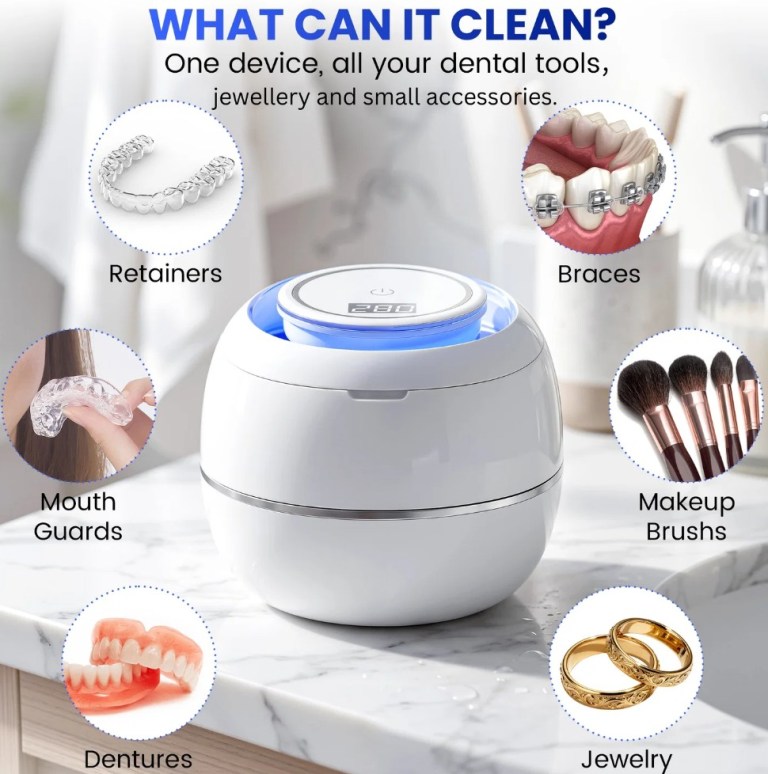
| Ultrasonic Cleaner: Dental Cleaning Pod (2026 Model) | Ultrasonic vibration cleaning; up to 300 ml capacity; one-touch operation; compact and portable design; multiple colour and plug options | 5- and 10-minute cleaning cycles | Retainers, dentures, aligners, mouth guards, night guards, jewellery, watches, and other small personal items |
| Zima Dental Pod | 42 kHz ultrasonic technology; designed specifically for dental and oral appliances | 5-minute automatic cleaning cycle | Dental appliances, including retainers and other oral appliances |
| iSonic DS180 | 36–41 kHz frequency; 25 W full-wave ultrasonic power; detachable power adapter | 3-minute automatic shutoff | Retainers, dentures, aligners, mouth guards, and small jewellery |
| Sonic Dental Sonic Spa Pro | 43 kHz ultrasonic cleaning; UV-C technology | 3- and 5-minute cleaning modes | Aligners, retainers, night guards, dentures, and toothbrush heads |
Each cleaner brings a different approach to everyday appliance care. Zima Dental Pod is mainly built around dental appliances, while iSonic DS180 provides detailed ultrasonic specifications for users who prefer a more technical option. Sonic Dental Sonic Spa Pro combines ultrasonic cleaning with UV-C technology. For users seeking greater flexibility, the Ultrasonic Cleaner: Dental Cleaning Pod (2026 Model) offers two cleaning cycles, up to 300 ml capacity, one-touch operation, and support for both dental appliances and other small personal items.
Manual and Ultrasonic Approaches to Retainer Cleaning
Manual cleaning remains an important part of retainer care. A soft toothbrush and an appliance-safe cleaning method can help remove visible debris. Gentle handling is preferred because aggressive scrubbing may scratch some retainer materials.
Ultrasonic cleaning takes different approach. Instead of direct brushing it uses sound waves within liquid to help loosen deposits. This provides an additional cleaning option for patients who regularly use removable retainers or other oral appliances.
The two approaches can fit into same care routine. Manual cleaning can address visible particles. An Ultrasonic Cleaner can then provide additional cleaning action around smaller surfaces. Patients should use methods that are appropriate for their specific appliance.
To maintain a retainer properly, patients should also pay attention to the following:
- Avoid very hot water unless the appliance manufacturer specifically allows it.
- Do not use abrasive products without professional guidance.
- Rinse the appliance after cleaning.
- Check the retainer regularly for cracks, warping, or other changes.
Toothpaste also deserves caution. Some toothpastes contain abrasive ingredients that may scratch certain plastic retainers. The patients can ask their dentist or orthodontist about suitable cleaning products for their particular appliance.
Retainer Cleaner Machine for Removable Dental Appliances
A retainer cleaner machine can provide a convenient option for patients who regularly care for removable dental appliances. Some ultrasonic devices are also suitable for aligners, mouthguards, dentures, and other compatible items. Before selecting a machine, patients should confirm that it is suitable for their particular appliance. Retainers can contain different materials, including plastic and metal components. The manufacturer’s instructions should always be reviewed before use.
An Ultrasonic Denture Cleaner may also be useful for patients who care for removable dentures or similar oral appliances. However, compatibility should always be checked before placing any dental appliance inside an ultrasonic device. Simple controls can make a dental cleaning machine easier to include in a regular care routine. Automatic shutoff can also be convenient. It allows the selected cleaning cycle to finish without constant monitoring.
Portability may be useful for patients who travel. A compact cleaner can take up less space in luggage or on a bathroom counter. Tank capacity is another consideration. The appliance should have enough room to sit properly during cleaning. Maintenance is equally important. The tank should be emptied and cleaned according to manufacturer’s instructions. Keeping your device clean can support more consistent appliance-care routine.
Dental Cleaning Machine Selection for Preventive Care
The selection of dental cleaning machine should begin with type of appliance being cleaned. Patients should review manufacturer’s recommendations and follow any specific instructions from their dentist or orthodontist. Cleaning intensity is another consideration. More powerful cleaning is not automatically better for every appliance. Some retainers are made from materials that require gentle handling. A compatible device is therefore more important than simply choosing the strongest machine.
Ease of use also matters for everyday care. Straightforward controls and clear cleaning cycles can make regular use easier. A removable tank or basket may further simplify handling and maintenance. Patients should also consider the machine’s overall construction. A durable design can be useful for repeated use. However higher price does not automatically mean that cleaner is more suitable for particular dental appliance.
For patients who looks for Ultrasonic Denture Cleaner then same considerations apply on this. Appliance compatibility, cleaning cycles, tank design and ease of maintenance should all be reviewed before making final choice. For preventive appliance care, consistency is often more practical than unnecessary features. A cleaner that fits easily into patient’s routine may be more useful than complicated model that is rarely used.
Conclusion
The best Ultrasonic Retainer Cleaner should offer practical cleaning features while being suitable for dental appliance being used. Ultrasonic technology can help loosen plaque, food particles and other deposits from surfaces that may be difficult to reach through manual cleaning alone.
An Ultrasonic Cleaner should complement regular appliance care rather than replace professional guidance. Patients should follow instructions for their specific retainer and use compatible cleaning methods and solutions. With suitable device and consistent routine then retainer maintenance can become more convenient. Patients should also continue rinsing, storing and handling their appliances properly. If retainer becomes cracked, warped, or damaged, consulting dental professional is appropriate next step.
