


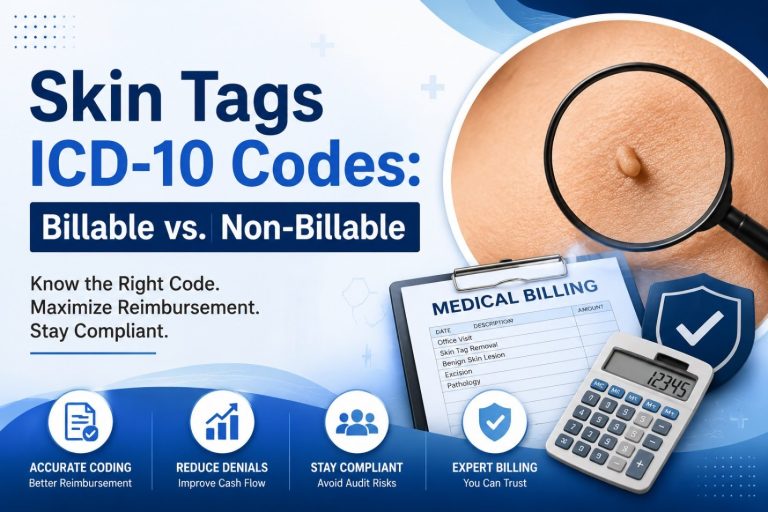
Connecticut Medical Billing, a trusted medical billing company, helps healthcare practices navigate diagnosis coding, medical-necessity requirements, payer policies, and claim submission challenges. Skin tag coding may appear straightforward, but confusion between billable and non-billable ICD-10-CM codes can result in rejected claims, coverage denials, or unnecessary payment delays.
The primary ICD-10-CM code commonly used for an ordinary skin tag, medically known as an acrochordon, is L91.8 — Other hypertrophic disorders of the skin. However, using a billable diagnosis code does not automatically mean that the removal procedure is covered by the patient’s insurance plan. Coverage depends on the reason for removal, clinical documentation, procedure coding, payer policy, and medical necessity.
What Is the ICD-10 Code for Skin Tags?

The ICD-10-CM category L91 is divided into more specific codes, including L91.0, L91.8, and L91.9. Because the category has been subdivided, L91 alone is not valid for claim submission. Current ICD-10-CM guidelines require codes to be reported to the highest number of characters and highest level of specificity supported by the medical record.
What Is a Skin Tag?
A skin tag is a small, soft, usually harmless skin growth. Its clinical name is acrochordon. Skin tags may be attached to the skin by a narrow stalk and commonly appear on the neck, eyelids, underarms, groin, beneath the breasts, and other areas where skin or clothing creates friction.
Most skin tags do not require treatment. Removal may be considered when a lesion becomes painful, repeatedly irritated, inflamed, itchy, prone to bleeding, or located where it interferes with vision or normal function. A patient may also request removal for appearance alone, but cosmetic removal is usually handled differently for insurance purposes.
Is L91.8 a Billable ICD-10 Code?
Yes. L91.8 is a billable and sufficiently specific ICD-10-CM code. Its official description is “Other hypertrophic disorders of the skin,” and it is the code commonly associated with a documented skin tag or acrochordon.
A billable code is specific enough to be placed on a healthcare claim. It does not need an additional character to become valid. Therefore, when the provider clearly diagnoses a standard skin tag and no more appropriate site-specific diagnosis applies, L91.8 may be reported.
However, billable does not mean automatically payable. CMS specifically states that correct ICD-10-CM coding does not guarantee coverage. The service must also be reasonable, medically necessary, properly documented, and consistent with the applicable coverage policy.
Why Is L91 a Non-Billable Code?
L91 is a three-character ICD-10-CM category, not the final code for a skin tag claim. It represents hypertrophic disorders of the skin and contains the following more specific child codes:
- 0:Hypertrophic scar
- 8:Other hypertrophic disorders of the skin
- 9:Hypertrophic disorder of the skin, unspecified
Because L91 has been subdivided, it cannot be used by itself on a claim. The FY 2026 ICD-10-CM Official Guidelines state that a three-character code may be used only when the category is not further subdivided. A code is invalid when it has not been reported with all required characters.
Submitting L91 instead of L91.8 may therefore produce a front-end claim rejection or an invalid-diagnosis-code edit before the payer evaluates medical necessity.
L91.8 vs. L91.9: Which Code Should Be Used?
L91.8 and L91.9 are both complete ICD-10-CM codes, but they do not mean the same thing.
Use L91.8 when:
The provider documents a skin tag, acrochordon, fibroepithelial polyp, or another specified hypertrophic skin disorder appropriately classified under this code.
Use L91.9 when:
The provider documents an unspecified hypertrophic disorder of the skin and there is not enough information to assign a more specific diagnosis.
L91.9 should not be selected simply because it is billable or because another code was denied. Coding must follow the condition documented by the treating provider. When the record clearly identifies a skin tag, L91.8 is generally more specific than L91.9. The official guidelines require reporting at the highest level of specificity supported by the record.
Billable Does Not Mean Covered
This distinction causes many skin tag removal denials.
A billable code is structurally valid for claim submission. A covered service is one that meets the patient’s benefit requirements and the payer’s medical-necessity policy.
For example, L91.8 may correctly identify a skin tag, but the payer can still deny removal when the medical record shows that the patient wanted the lesion removed only because of its appearance.
Medicare considers the removal of a benign skin lesion cosmetic when the lesion does not threaten the patient’s health or function. Cosmetic services are generally not covered. Medicare may consider removal medically necessary when the record clearly documents qualifying symptoms or functional problems.
When Can Skin Tag Removal Be Medically Necessary?
Coverage requirements vary by payer and Medicare Administrative Contractor, but medical necessity may be supported when a skin tag has one or more clinically significant characteristics, such as:
- Recurrent bleeding
- Intense itching
- Pain or tenderness
- Oozing, swelling, redness or other evidence of inflammation
- Repeated trauma from clothing, jewelry, shaving or movement
- Obstruction of an opening
- Interference with vision
- Clinical concern that the lesion may not be benign
A vague statement such as “irritated skin lesion” may not be sufficient. CMS guidance emphasizes documenting the patient’s symptoms and the provider’s objective physical findings rather than relying on a general description alone.
The record should explain how the lesion affects the patient. For example, documentation that a neck skin tag repeatedly catches on clothing and bleeds is stronger than merely stating that the lesion is bothersome.
Primary and Secondary Diagnosis Coding
Some payer policies require more than the diagnosis identifying the lesion. The claim may need:
- A primary diagnosis identifying the skin tag or benign lesion; and
- A secondary diagnosis identifying the documented complication, symptom or reason the removal is medically necessary.
Under one CMS billing article, L91.8 appears among the diagnoses for which a primary lesion code and a secondary diagnosis representing a complication may be required. The same policy includes secondary diagnoses such as pruritus and certain pain, infection, inflammation, visual or skin-sensation conditions. Requirements are policy-specific and should not be applied automatically to every payer.
Coders should never add a symptom code solely to obtain payment. The secondary diagnosis must be supported by the provider’s documentation and must accurately represent the patient’s condition.
Skin Tags That May Require a Different ICD-10 Code
Not every growth described informally as a “skin tag” should be coded with L91.8. The final code depends on the provider’s diagnosis, anatomical location, pathology results and clinical circumstances.
Residual hemorrhoidal skin tags
K64.4 — Residual hemorrhoidal skin tags may be appropriate when the provider specifically diagnoses a residual hemorrhoidal or anal skin tag. It should not be replaced with L91.8 merely because both conditions may be called skin tags.
Congenital ear or preauricular lesions
A congenital accessory auricle or preauricular lesion may fall under a congenital code, such as Q17.0, depending on the exact diagnosis. It should not automatically be classified as an acquired acrochordon.
Lesions with uncertain behavior
When a provider is uncertain whether a lesion is benign and performs a diagnostic biopsy, a neoplasm-related diagnosis may be appropriate based on the documented clinical assessment. Coders should not assign D48.5 or another uncertain-behavior code merely because tissue was sent to pathology; the provider’s diagnostic statement and coding guidelines must support it. CMS notes that D48.5 or D49.2 may be applicable when malignancy has not been established at the time of biopsy.
A different final pathology diagnosis
A lesion initially believed to be a skin tag may later be identified as a nevus, wart, neurofibroma, seborrheic keratosis or another condition. When appropriate, coding should reflect the confirmed final diagnosis rather than continuing to report L91.8.
ICD-10 Codes vs. Procedure Codes
ICD-10-CM codes explain why the patient received the service. Procedure codes explain what the healthcare provider performed.
For a skin tag encounter:
- 8may identify the diagnosis.
- A CPT or HCPCS code identifies the examination, removal, biopsy or other procedure.
- An additional diagnosis may identify pain, itching, bleeding, inflammation or functional impairment when documented and required by payer policy.
Skin tag removal is frequently associated with the CPT 11200–11201 code family. However, procedure-code selection depends on factors such as the number of lesions treated, the technique performed, bundling requirements and current CPT instructions. Practices should verify the active code set and payer policy rather than choosing a procedure code based only on the diagnosis.
Documentation Needed for a Clean Skin Tag Claim
A defensible medical record should identify:
The diagnosis: Clearly state “skin tag” or “acrochordon” rather than using an unclear term such as “spot” or “growth.”
The anatomical location: Document where each treated lesion is located.
The number of lesions: Record the number examined and the number actually removed.
Symptoms: Describe pain, itching, bleeding, inflammation, recurrent trauma or other relevant complaints.
Objective findings: Document erythema, swelling, oozing, ulceration, active bleeding, obstruction or other examination findings.
Functional effect: Explain whether the lesion restricts vision, catches on clothing, interferes with movement or creates another functional problem.
The treatment performed: Record the removal technique and any local anesthesia, specimen handling or related care.
The reason for removal: Make it clear whether the procedure was medically necessary or requested for cosmetic purposes.
CMS guidance warns that generic descriptions without supporting signs, symptoms and physical findings may be insufficient to establish medical necessity.
Common Skin Tag Coding and Billing Errors
Submitting L91 instead of L91.8
L91 is an incomplete category because more specific child codes are available. It should not be submitted as the final diagnosis code.
Assuming L91.8 guarantees reimbursement
L91.8 is billable, but a payer may still deny cosmetic or inadequately documented removal.
Using an unspecified code without justification
L91.9 should not replace L91.8 when the record clearly identifies an acrochordon.
Failing to document medical necessity
Writing only “irritated skin tag” may not demonstrate why the removal was necessary. The record should describe the specific symptoms and findings.
Adding unsupported symptom codes
Pain, itching, bleeding or inflammation codes should be reported only when the conditions are documented and relevant to the encounter.
Ignoring site-specific diagnoses
Residual hemorrhoidal skin tags, congenital ear tags and lesions with a different confirmed diagnosis may require codes other than L91.8.
Coding before reviewing pathology
When pathology produces a more definitive diagnosis, the coding team should review whether the final claim needs to reflect that diagnosis.
How to Reduce Skin Tag Claim Denials
Healthcare practices can improve claim accuracy by confirming the following before submission:
- The provider documented a clear diagnosis.
- The ICD-10-CM code is complete and specific.
- Cosmetic and medically necessary services are separated appropriately.
- Symptoms and objective findings are included in the medical record.
- The diagnosis supports the procedure performed.
- Any required secondary diagnosis is documented.
- The patient’s benefits and payer policy have been checked.
- The claim follows current ICD-10-CM, CPT and modifier rules.
A code should never be changed merely to bypass a denial. When a claim is rejected, the practice should identify whether the problem involves code validity, documentation, patient eligibility, coverage criteria, bundling, authorization or another payer edit.
Frequently Asked Questions
What is the most common ICD-10 code for a skin tag?
The most commonly used ICD-10-CM code for a standard skin tag or acrochordon is L91.8, Other hypertrophic disorders of the skin.
Is L91.8 billable?
Yes. L91.8 is a complete and billable ICD-10-CM code. Payment still depends on medical necessity, documentation and payer policy.
Is L91 billable?
No. L91 is a category that has been divided into more specific codes. A code from the appropriate subcategory must be selected.
Does insurance cover skin tag removal?
Insurance may cover removal when the lesion causes documented symptoms or functional impairment and the service satisfies the payer’s policy. Removal solely to improve appearance is generally considered cosmetic and is commonly excluded from coverage.
Can L91.9 be used for a skin tag?
L91.9 should be used only when the provider documents an unspecified hypertrophic skin disorder and a more specific diagnosis cannot be assigned. When a skin tag or acrochordon is clearly documented, L91.8 is generally the more specific option.
What code is used for a hemorrhoidal skin tag?
K64.4 is used for residual hemorrhoidal skin tags when that diagnosis is documented.
Is a secondary diagnosis always required with L91.8?
No universal rule applies to every payer. Some coverage policies require a secondary diagnosis representing a documented complication, while others follow different criteria. Verify the patient’s plan and applicable Medicare Administrative Contractor policy before billing.
Final Takeaway
For an ordinary documented skin tag or acrochordon, L91.8 is the primary billable ICD-10-CM code commonly used. The category code L91 is non-billable because it does not provide the full level of detail required for claim submission.
The larger billing risk is assuming that a valid diagnosis code guarantees reimbursement. Skin tag removal may be denied when it is cosmetic, when medical necessity is unclear, when the wrong anatomical diagnosis is used, or when symptoms and physical findings are missing from the record.
Accurate diagnosis selection, detailed clinical documentation, correct procedure coding and payer-policy verification are all necessary for cleaner claims. Connecticut Medical Billing can support healthcare practices with coding review, claim submission, denial management and revenue-cycle processes designed to reduce avoidable billing errors.
