



Walk into a modern doctor’s office in 2026, and the experience starts to feel subtly different. The waiting room hasn’t changed. The questions your doctor asks are still the same. But somewhere in that exam room, artificial intelligence is now quietly working in the background.
It might be listening to the conversation and transcribing it into your chart. It might have already reviewed your X-ray before your doctor opened your file. It could be the chatbot you used the night before to understand an unfamiliar symptom. It might even be the reason your appointment was matched to the right specialist in the first place.
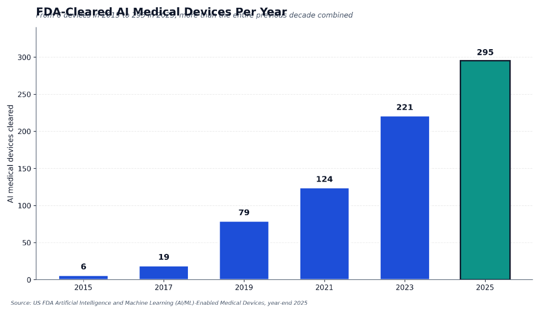
This isn’t a future possibility anymore. By the end of 2025, the US Food and Drug Administration had cleared 1,451 AI medical tools. Nearly 300 of those came through in 2025 alone, more than the entire previous decade combined. Patients have moved just as quickly. A 2026 Wolters Kluwer survey found that more than half of patients now use AI to look up health information.

So what does this mean for you as a patient? This guide walks through where AI shows up in your healthcare today, what problems it solves, the benefits it delivers, the limits worth knowing, and what you can do to stay informed at your next visit.
AI in the Exam Room and Clinical Documentation
The clinician documentation burden
US doctors spend more time typing into electronic health records than talking to patients. A widely cited Annals of Internal Medicine study found documentation now takes roughly two hours for every hour of direct patient care. That imbalance has been a major driver of clinician burnout. AI is starting to fix it.
How ambient AI scribes work
An ambient AI scribe quietly listens during the visit, captures the conversation, and converts it into a structured clinical note. The doctor reviews and signs off, instead of writing it after hours of back-to-back appointments. Microsoft’s Dragon Copilot recorded over 3 million patient conversations in March 2025 across 600 healthcare organizations. In 2026, the US Department of Veterans Affairs announced a rollout to every VA medical center, the largest government healthcare AI deployment in US history.
Measured impact across US hospitals
- A 2025 UCLA study found AI scribes significantly reduced doctor burnout across 14 specialties
- Emory Healthcare reported a 30 percent improvement in physician well-being around documentation
- Intermountain Health recorded a 27 percent reduction in time spent finishing notes
- A London hospital trial gave patients 23.5 percent more direct face time with their doctor
Patient consent and your right to opt out
Data from these tools is protected under HIPAA. According to a 2026 American Hospital Association survey, less than 1 percent of patients refuse the recording once their doctor explains how it works. The choice is yours. You can decline at any point, and your visit continues as normal.
AI in Medical Imaging and Diagnostics
Why was radiology the entry point
Radiologists review hundreds of images per shift, often under fatigue, with cases that can include hundreds of CT slices per patient. Subtle patterns indicating early-stage cancer, a small stroke, or a hairline fracture can be missed due to cognitive load. Studies show radiologist miss rates on screening mammograms hover between 10 and 30 percent depending on tissue density. That gap is where AI is making a difference.
AI as a second reader for the radiologist
Of the 1,451 FDA-approved AI medical tools, 1,039 (about 76 percent) are radiology tools. They flag suspicious areas while the human radiologist reviews and signs off. In 2015, the FDA cleared just 6 AI medical devices in the entire year. In 2025 alone, that number was 295, more than the previous decade combined.
Clinical applications in routine use
- Detecting early-stage breast cancer on screening mammograms
- Identifying strokes on brain CT scans where minutes matter
- Flagging suspicious lung nodules on chest X-rays
- Spotting fractures and bone abnormalities on routine imaging
Expansion into pathology and laboratory medicine
The same approach is now reaching pathology and laboratory medicine. AI tools help pathologists scan biopsy slides under digital microscopes, identifying suspicious cells in minutes rather than hours. Machine learning models also flag unusual blood cell patterns in routine bloodwork.
For readers interested in how lab tests are coded and billed behind the scenes, this laboratory billing guide explains the CPT codes that doctors and labs use.
The role of the human radiologist
AI improves accuracy in well-defined screening tasks. It does not replace the radiologist or pathologist. The final clinical interpretation belongs to the human expert who signs off on your results and decides what to do next. The reader of your scan in 2026 is still a board-certified physician, with AI assistance.
AI Chatbots and Symptom Checkers
A growing patient behavior
Talking to an AI chatbot about symptoms is now a routine first step for millions of Americans. A 2026 Wolters Kluwer survey found 52 percent of patients use AI tools like ChatGPT, Gemini, or Claude to research conditions, and 54 percent use them to look up drug information. The question is no longer whether people use these tools, but how much they can trust the answers.
Findings from the Penn State accuracy study
The 2026 Penn State Diagnose-a-thon study put ChatGPT, Gemini, and Llama through 212 health questions across 12 specialties, scored by nine board-certified physicians. Overall accuracy was 76.2 percent. Performance was strongest in obstetrics and ENT (above 85 percent) and weakest in internal medicine, neurology, and dermatology. Chatbot reliability depends heavily on the type of question being asked.

Using AI chatbots responsibly
Use them for:
- Understanding a diagnosis already given by your doctor
- Preparing better questions before your appointment
- Tracking how your symptoms change over time
Avoid them for:
- Self-diagnosing serious or complex symptoms
- Deciding whether to seek emergency care
- Interpreting test results without a doctor
If an AI response causes concern, follow up directly with your doctor.
AI in Mental Health Care
The US mental health access gap
Roughly half of US counties don’t have a single practicing psychiatrist. Even in major cities, the average wait to see a therapist runs six to eight weeks, and an hour of evidence-based therapy costs between 150 and 250 dollars out of pocket.
FDA-recognized AI mental health apps
Two AI mental health apps have reached FDA Breakthrough Device status. Wysa received the designation in 2025 for chronic pain and depression. Woebot received it earlier for postpartum depression. Both deliver cognitive behavioral therapy through structured text-based conversations. Neither claims to replace a therapist, and both are positioned as a first line of support that can bridge the wait for clinical care.
Clinical trial findings
- A 2024 Wysa trial with chronic disease patients showed significant reductions in depression and anxiety symptoms over 4 weeks
- A 2023 Woebot trial of its teen depression program was about as effective as therapy with a human clinician
Situations beyond their clinical scope
These apps can’t handle thoughts of self-harm, severe panic attacks, psychotic symptoms, or substance use crises. In those cases, crisis lines, emergency rooms, and licensed clinicians remain the right point of contact.
AI in Telemedicine and Online Visits
The telemedicine workflow problem
Telemedicine became mainstream during the pandemic and never retreated. By 2026, between 25 and 38 percent of US outpatient visits happen virtually depending on the specialty. But the back-end is still slow. AI is now being layered on top of these workflows to fix the bottlenecks.
AI in appointment matching and scheduling
AI now matches patients to the right specialists, checks real-time availability, sends smart reminders, and triages incoming concerns. For follow-ups, refills, and routine questions, online visits with AI support are often faster than driving to a clinic. In Pakistan, Marham, the country’s largest telemedicine platform with more than 16,000 verified doctors, has been used by over 10 million patients.
For patients considering an online consultation, the benefits of scheduling doctor appointments online are worth understanding before your next visit.
AI in prior authorization and billing
Insurance and billing has historically been one of the slowest parts of US healthcare. Prior authorizations once took days. AI tools now process the bulk in minutes by matching clinical notes to insurer coverage criteria and flagging only edge cases for human review.
For a deeper look at how AI is touching different corners of healthcare, from imaging and drug discovery to clinical workflows, these healthcare ai blogs offer useful further reading.
A Practical Patient Checklist
You have more say in this AI-shaped healthcare system than you might realize. The checklist below covers five things worth keeping in mind at any future appointment.

Closing Thoughts: AI as a Partner in Care
AI in healthcare in 2026 is solving real problems. It’s reducing physician burnout, catching abnormalities the human eye misses, and giving patients faster access to specialists and mental health support. Its limits matter too. AI doesn’t make final clinical decisions, it doesn’t replace the doctor who knows your history, and it can’t manage serious mental health emergencies. The strongest results come when AI works as a partner alongside trained clinicians. Use the technology where it helps. Stay informed about its limits. Take an active role in your own care.
