


By George King, Engineering Manager, Fitiger Life Inc.
Why Choking Readiness Is a Workflow Issue
Healthcare safety conversations often focus on the device, the training course, or the written policy. Those pieces matter, but emergencies often expose a different weakness: the workflow between recognition and action.
Choking incidents can happen in homes, schools, care settings, restaurants, break rooms, clinics, or long-term care facilities. The first seconds are rarely tidy. Someone notices distress. Another person tries to interpret what is happening. A responder looks for help, equipment, or a phone. In many settings, the problem is not that people do not care. It is that the response path was never designed as a usable system.
That makes choking readiness a useful case study for healthcare teams, facility leaders, and safety planners. Current resuscitation guidance treats foreign-body airway obstruction as a time-sensitive emergency and emphasizes scene safety, activation of emergency response, recognition of severe obstruction, and appropriate trained response steps [1,2].
Start With Recognition, Not Equipment
A response workflow begins before anyone reaches for a tool. It starts with recognition. Can staff, caregivers, teachers, or family members recognize a possible choking emergency quickly? Do they know how to distinguish effective coughing, partial obstruction, and severe airway distress well enough to act according to their training and local protocol?
In real environments, recognition is complicated by noise, crowds, stress, and bystander uncertainty. A school cafeteria, senior dining area, restaurant floor, or care-facility meal service is not a quiet training room. Food-allergy emergency guidance for schools makes a similar operational point: staff roles, professional development, emergency planning, and daily management need to be built into the environment rather than assumed in the moment [3].
A practical audit asks simple questions:
- Where do people eat, take medication, or receive assistance with meals?
- Who is usually nearby when an incident begins?
- What is the first action expected from that person?
- How is help called without leaving the person alone?
- What should bystanders do, and what should they avoid doing?
Map the Response Path
Many emergency plans describe what should happen, but not how it happens in the room. A better approach is to map the response path from the point of discovery.
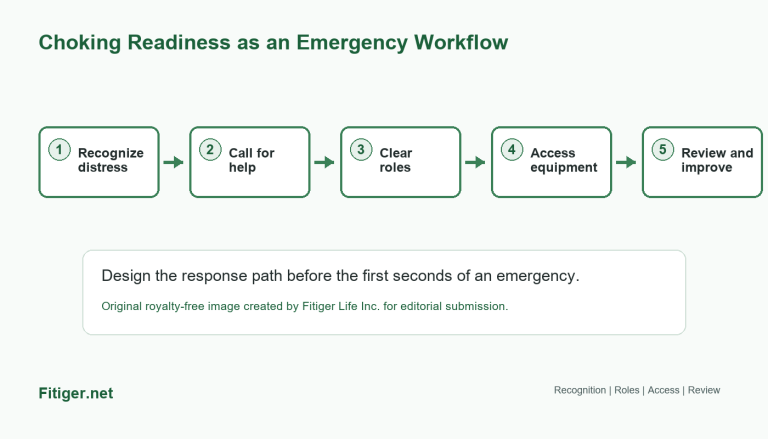
For example, in a workplace dining area, the path might include recognition, calling emergency services, notifying the trained first aid responder, clearing space, locating emergency equipment, documenting the incident, and reviewing the response afterward. In a care setting, the path may also include resident-specific risk notes, supervision levels, dietary restrictions, and staff handoff procedures.
The point of mapping is to find delays. Does the responder know where equipment is stored? Is it behind a locked door? Is the trained person usually on another floor? Does the phone workflow require a manager? Are substitute staff included in drills? Are visitors or family members likely to interrupt or crowd the response area?
Treat Equipment Placement as a Design Decision
Emergency tools should not be placed only where they are easy to store. They should be placed where they are easy to find under stress.
This principle applies broadly: AEDs, first aid kits, emergency oxygen where applicable, suction-related equipment in clinical settings, and other emergency-response resources. For choking readiness, teams should think about the distance between likely incident locations and the nearest appropriate response resource.
Good placement is visible, consistent, and easy to explain. If a staff member needs a map, a key, or permission from a supervisor before accessing emergency equipment, the workflow may fail at the worst possible moment.
Training Needs a Refresh Cycle
Training should not be treated as a one-time certificate. People forget. Teams change. Facilities reorganize. Meal areas move. New products are introduced. Policies are updated.
A useful refresh cycle does not always require a long class. Short scenario reviews, tabletop discussions, shift huddles, or annual readiness checks can reinforce the sequence of action. The goal is to make the first few steps familiar enough that staff do not have to invent them during an emergency.
For healthcare and care environments, training should stay aligned with approved protocols, professional guidance, and local regulatory requirements. For schools and workplaces, readiness planning should stay aligned with first aid training, emergency action plans, and local emergency service expectations.
Avoid Overconfidence in Any Single Tool
One common mistake in emergency planning is assuming that a single tool solves the workflow. It does not. Devices can support a response, but they do not replace recognition, training, judgment, emergency calling, documentation, or post-incident review.
This is especially important in public-facing education. Any emergency tool should be described with clear limits. Teams should understand when it may be considered, who is expected to use it, how it fits with existing first aid procedures, and what follow-up steps remain necessary after use.
Review After Incidents and Near Misses
A choking-related near miss can be valuable if it leads to improvement. Post-incident review should be calm, factual, and focused on systems rather than blame.
- Was the incident recognized quickly?
- Was help called according to the plan?
- Did staff know their roles?
- Was equipment accessible and ready?
- Were there communication gaps?
- Did documentation capture what happened?
- What should change before the next incident?
Build Readiness Around Real Rooms
The strongest emergency plans are designed around real rooms, real people, and real behavior. Choking readiness should not be treated as a narrow first aid topic. It is a workflow-design problem that touches training, access, communication, equipment inspection, and after-action learning.
A practical readiness program does not need to be dramatic. It needs to be specific. Where might the emergency happen? Who sees it first? What do they do? Where is help? What tools are available? How do we know the system worked?
References
[1] American Heart Association. 2025 Guidelines for CPR and Emergency Cardiovascular Care: Adult Basic Life Support. Circulation. 2025. https://www.ahajournals.org/doi/10.1161/CIR.0000000000001369
[2] American Heart Association. Adult Foreign-Body Airway Obstruction Algorithm. 2025 Algorithms. https://cpr.heart.org/en/resuscitation-science/cpr-and-ecc-guidelines/algorithms
[3] Centers for Disease Control and Prevention. Food Allergies in Schools: Managing Health Conditions in School. https://www.cdc.gov/school-health-conditions/food-allergies/index.html
[4] American Academy of Pediatrics. Management of Food Allergy in Schools: Clinical Report. Pediatrics. 2025;156(6):e2025073168. https://publications.aap.org/pediatrics/article/156/6/e2025073168/203214/Management-of-Food-Allergy-in-Schools-Clinical
