


Quick Summary
| Medical coding is the backbone of healthcare reimbursements — but it’s slow, error-prone, and increasingly overwhelming for human coders. What if AI could fix that?
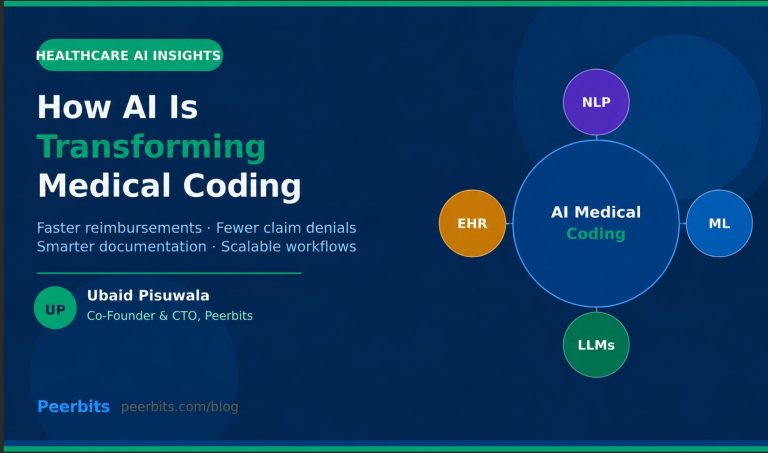
In this article, we break down exactly how Artificial Intelligence — powered by NLP, Machine Learning, and Large Language Models — is reshaping the way healthcare organizations handle ICD-10 and CPT coding. From cutting claim denials to real-time EHR assistance, AI is no longer a future promise. It’s already here. Whether you’re a healthcare IT leader, RCM professional, or healthtech founder — this is your practical guide to understanding AI’s impact on medical coding, and what it means for your organization’s bottom line. |
————————————————————-
Healthcare organizations are under increasing pressure to improve operational efficiency, reduce claim denials, accelerate reimbursements, and maintain coding accuracy. Traditional medical coding processes—largely dependent on manual review and repetitive documentation tasks—often create bottlenecks in revenue cycle management (RCM).
Artificial Intelligence (AI) is rapidly changing this landscape.
From automated code suggestions to intelligent clinical documentation analysis, AI-powered medical coding solutions are helping healthcare providers modernize coding workflows while improving accuracy and scalability.

Understanding Traditional Medical Coding Challenges
Medical coding plays a critical role in healthcare reimbursement and compliance. Coders translate clinical documentation into standardized billing codes such as ICD-10, CPT, and HCPCS.
However, manual coding workflows often face several challenges:
- Time-consuming chart reviews
- High administrative burden
- Documentation inconsistencies
- Coding inaccuracies
- Claim denials and reimbursement delays
- Staffing shortages and coder burnout
As healthcare data volumes continue to grow, many organizations are exploring AI-driven automation to optimize coding operations.
How AI Is Changing Medical Coding Workflows
Modern AI systems use technologies such as:
- Natural Language Processing (NLP)
- Machine Learning (ML)
- Large Language Models (LLMs)
- Clinical language understanding
- Context-aware automation
These technologies help extract clinical meaning from physician notes, discharge summaries, SOAP notes, and EHR records.
Instead of relying entirely on manual review, AI systems can now assist coders by identifying relevant diagnoses, procedures, and supporting documentation in real time.
Organizations implementing AI medical coding solutions are increasingly leveraging automation to improve coding consistency and reduce operational inefficiencies.
Key Areas Where AI Improves Medical Coding Workflows

1. Automated Clinical Documentation Analysis
AI can process large volumes of unstructured clinical text and identify relevant coding elements automatically.
This includes:
- Diagnoses
- Procedures
- Clinical conditions
- Medication references
- Comorbidities
- Treatment documentation
By analyzing documentation contextually, AI reduces the time coders spend manually reviewing charts.
2. Faster ICD-10 and CPT Code Assignment
AI-powered systems can recommend appropriate ICD-10 and CPT codes based on clinical documentation patterns.
Benefits include:
- Faster coding turnaround
- Reduced repetitive tasks
- Improved coding productivity
- Better coding standardization
These capabilities are particularly valuable for high-volume healthcare environments such as hospitals, RCM companies, and multi-specialty practices.
3. Reduction in Claim Denials
Incorrect or incomplete coding is one of the leading causes of claim denials.
AI systems help identify:
- Missing documentation
- Incomplete coding
- Coding inconsistencies
- Potential compliance issues
As a result, organizations can improve clean claim rates and optimize reimbursement workflows.
AI-driven automation is becoming an important part of broader healthcare revenue cycle modernization strategies.
4. Improved Coding Accuracy
AI systems continuously learn from historical coding patterns, documentation quality, and payer requirements.
This helps improve:
- Coding consistency
- Clinical specificity
- Documentation alignment
- Audit preparedness
Human coders still play a critical role, but AI acts as an intelligent assistant that enhances productivity and reduces error rates.
5. Real-Time Coding Assistance
Modern AI coding platforms can provide real-time coding suggestions during clinical documentation workflows.
When integrated with EHR systems, AI can assist clinicians and coding teams simultaneously.
Organizations investing in healthcare interoperability and EHR integration services are increasingly enabling these real-time automation capabilities across healthcare ecosystems
The Role of NLP and Generative AI in Medical Coding
Natural Language Processing enables AI systems to understand clinical language, abbreviations, and context.
Meanwhile, Generative AI and Large Language Models are introducing advanced capabilities such as:
- Intelligent documentation summarization
- Context-aware code recommendations
- Clinical note interpretation
- Automated workflow assistance
These technologies are pushing medical coding beyond rule-based automation toward more intelligent decision support.
AI Medical Coding and Clinical Documentation Improvement (CDI)
Clinical Documentation Improvement (CDI) programs aim to ensure accurate and complete documentation.
AI supports CDI initiatives by:
- Identifying missing specificity
- Detecting incomplete documentation
- Highlighting coding gaps
- Improving documentation quality
This creates stronger alignment between clinical care, coding, billing, and reimbursement operations.
Integration with Modern Healthcare Systems
AI medical coding platforms are most effective when integrated with:
- EHR systems
- Practice management software
- RCM platforms
- Billing systems
- Interoperability frameworks
Standards such as SMART on FHIR and HL7 are helping healthcare organizations build scalable and interoperable automation workflows.
Challenges in AI Medical Coding Adoption
Despite the advantages, implementation still comes with challenges:
- Healthcare data quality issues
- EHR integration complexity
- Compliance requirements
- Workflow adaptation
- AI governance concerns
- Human oversight requirements
Successful implementation requires careful planning, interoperability expertise, and strong compliance frameworks.
The Future of AI in Medical Coding
AI is expected to become a core component of modern healthcare revenue cycle operations.
Future capabilities may include:
- Autonomous coding assistance
- Predictive denial prevention
- Real-time compliance monitoring
- Intelligent documentation optimization
- Multi-specialty workflow automation
Rather than replacing human coders entirely, AI is more likely to augment coding teams and help organizations manage increasing documentation complexity efficiently.
Final Thoughts
AI is fundamentally transforming medical coding workflows by improving speed, consistency, and operational efficiency across healthcare organizations.
As healthcare systems continue to digitize and data volumes increase, intelligent automation will play an increasingly important role in supporting scalable revenue cycle operations.
Organizations exploring AI-driven healthcare transformation are now investing in technologies such as:
- AI medical coding
- Clinical documentation automation
- Interoperability platforms
- Intelligent workflow optimization
- Healthcare AI integration
The combination of AI, interoperability, and workflow automation is shaping the future of healthcare operational efficiency.
