


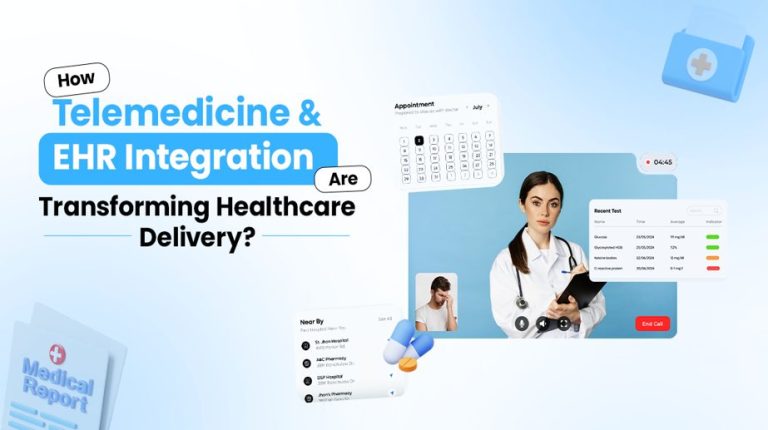
Healthcare delivery has always been a challenging thing; patients in rural and underserved areas face long waiting times, limited access to healthcare facilities, and scattered medical records. The healthcare service providers often face issues with paperwork, data management, and also in the administrative process. Telemedicine acts as a great digital solution that meets the gap between patients and doctors, providing beneficial remote consultations and timely patient care.
On the other hand, EHR (Electronic Health Records) systems organize & secure patient data, making it accessible whenever it is needed. But the real transformation actually worked when telemedicine and EHR work together. Integrating virtual healthcare with centralized health records, healthcare organizations can ensure smooth healthcare operations, minimize errors, be able to address long-term challenges, and also have an efficient patient-centric system that is quite impressive.
In this blog, we will be exploring how telemedicine & EHR are together changing the healthcare delivery process, meeting the gaps, enhancing the patient outcomes, and also reshaping the medical outcomes, offering incredible results.
Combined Effect of Telemedicine & EHR Integration in the Healthcare System
Telemedicine helps patients to have a remote consultation with the doctors, thus minimizing the barrier of an in-person visit to the clinic. This is mainly coordinated for the routine checkups, follow-ups, and also for the consultations that are accessible within the EHR system. And the EHR can store data digitally, organize it, and manage the patient information effectively, starting from the patient’s medical history and laboratory results to treatment plans.
With these two technologies working collaboratively, the collected data during the virtual visits is documented automatically and also made accessible with the EHR system. With the amazing integration, there is a unified, real-time health record that healthcare providers can refer to during their patient consultation. So, basically, do you know what the result is? There is more accurate informed decision-making, fewer errors, and also seamless care regardless of the location of the provider or the patient. Despite having these major advantages, its adoption in highly specialized areas has faced quite hurdles, which is why it is significant to understand the barriers that have been faced while adopting EHRs in cardiology and the solutions that they have overcome.
Let’s see how telemedicine and EHR are actually changing the healthcare space, giving an improved care experience to the patients.
Ways in which Telemedicine & EHR Are Changing Healthcare
The best ways in which telemedicine and EHR are transforming healthcare operations are listed below.
Improving Patient Care
With the advent of these useful technologies, there is a great transformation in patient-centered care, and along with telemedicine in EHR.
- Healthcare providers can have great accessibility to medical histories, allergies, and also to treatments during virtual consultations.
- Personalized treatment plans are easier to create and follow, especially for patients who are seeing multiple specialists.
- There is also an improvement in chronic disease management that provides healthcare service providers, which helps in tracking patients’ progress.
For example, a diabetic patient can share their EHR related to blood sugar during a telehealth visit that automatically updates, allowing the service providers to adjust medication in real time.
Enhancing Operations
The healthcare organizations face administrative issues, and with the integration of EHR with telemedicine, there is streamlining of the workflow management. Some of the approaches that enhance the operations are
- Appointment scheduling with reminders and automated follow-ups.
- There is a proper flow of documents from virtual visits into the EHR that reduces manual paperwork.
- There are faster billing and insurance claims, as the consultation records are quite standardized & accessible.
Increasing Accessibility to Care
Telemedicine with EHR integration improves healthcare accessibility for patients who live in remote and underserved areas.
- Patients can easily consult specialists without having long-distance travel.
- Patients having mobility issues can also receive the care services from their home.
- With EHR integration, there is great accessibility for accurate & up-to-date health information.
With this combination of technologies in the healthcare space, there is great continuity of care, faster interventions, better patient outcomes, and also up-to-date health information despite whatever is the location.
Developed Data & Compliance
The healthcare service providers can handle sensitive patient data records as per the standard compliance, like HIPAA. The integrated telemedicine & EHR systems offer;
- Secured transmission of patient data during remote & virtual consultations.
- Has strong encryption and great accessibility controls for safeguarding sensitive health data.
- Helps in tracking data for the patients & ensures compliance standards.
With this integration of EHR and Telemedicine, patients are able to build trust while ensuring strict guidelines and maintaining all the healthcare requirements.
Now that you have understood how Telemedicine and EHR are transforming the healthcare processes, let’s see how they overcome these challenges.
Challenges in Integrating Telemedicine & EHR
With all the benefits being clear, integrating telemedicine with EHR systems has some challenges.
- Interoperability
There is a big concern and challenge, which is interoperability. This mainly occurs with the ability of different telemedicine platforms & EHR systems that mainly coordinate the communication and data exchange process. It has been observed that many of the service providers often provide EHR from different vendors that don’t possess a common standard, thus creating challenges in the integrated healthcare process.
- Data & Security Concerns
With the aspect of virtual consultations, there is often an occurrence of privacy and cybersecurity concerns. So any kind of breach leads to repercussions and financial losses, breaking the patient’s trust.
- Training
Integration of these technologies is not only meant for any technical setup, but also has organizational adaptation. Also, they are facing challenges, particularly in the case of navigating workflows that lead to inefficiency. With changes in the management, there is a need for training to overcome such integration challenges in the healthcare process.
- Cost & Infrastructure Aspects
There are also challenges with the aspect of financial management in the case of EHR & Telemedicine, while securing servers, handling networks, and also with the ongoing maintenance.
So, overcoming these potential challenges in integrating EHR and Telemedicine is possible with a strategic approach that results in improved efficiency and a truly connected experience that paves the way for healthcare.
Conclusion
So, the incorporation of technologies like EHR & Telemedicine in the healthcare sector is not just an upgrade but a total shift in the healthcare operations. By connecting through remote/video consultations with centralized patient records, service providers offer much faster, smarter, and personalized care. Patients have benefited from convenience, and healthcare service providers have better accessibility for strategic decision-making.
However, establishing this great transformation requires thoughtful planning, the right tools, and trusted technology partners. That’s when working with a professional healthcare app development company can make a huge difference. Starting from building interoperable systems to ensure data security, with the right partner, there is always embracing of digital healthcare with impactful results. In the coming years and future ahead, it can be said that EHR and telemedicine can blend into redefining the patient care system, making healthcare accessible to everyone.
