



Executive Overview
India’s medical device sector now operates within a comprehensive regulatory framework supervised by the Central Drugs Standard Control Organization (CDSCO) under the Medical Device Rules, 2017 (MDR 2017). As of 2026, every imported medical device—regardless of classification—must obtain an official import license through the CDSCO’s digital SUGAM portal before entering the Indian market.
This article outlines the essential regulatory components manufacturers must understand, including:
- India’s risk-based device classification structure
- The mandatory appointment of an Indian Authorized Agent (IAA)
- The import licensing pathway from Form MD-14 to Form MD-15
- Key documentation requirements such as the Plant Master File (PMF), Device Master File (DMF), and Free Sale Certificate (FSC)
- Ongoing post-market compliance and vigilance obligations
The purpose of this guide is to provide clear regulatory insight and practical understanding for manufacturers planning compliant and sustainable entry into India.
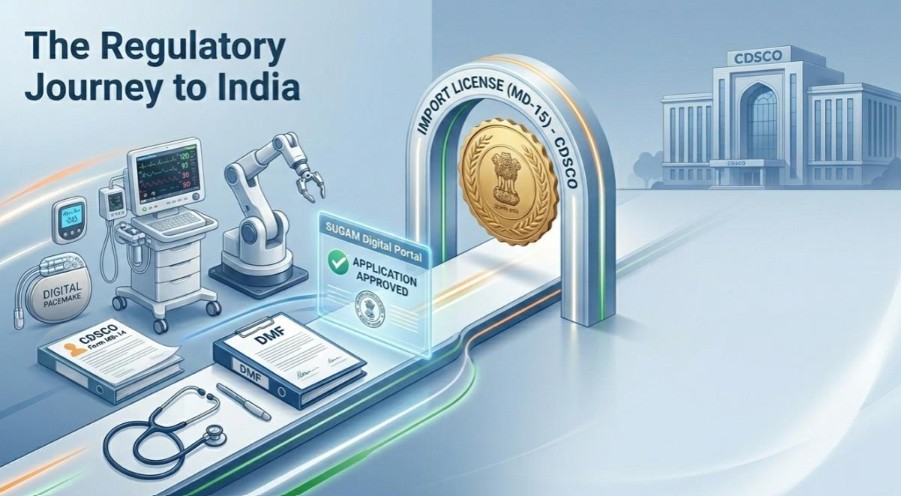
1. The Modern Indian Medical Device Regulatory Landscape
Over the last decade, India has transformed its medical device oversight system from limited regulation to a fully structured legal regime. The Central Drugs Standard Control Organization, functioning under the Ministry of Health and Family Welfare, is the national authority responsible for supervising medical devices across the country.
The enforcement of the Medical Device Rules, 2017 marked a significant regulatory milestone. Through subsequent government notifications issued between 2020 and 2025, the scope of regulation was progressively expanded to include all medical devices.
For overseas manufacturers, this evolution carries important implications:
- The previous voluntary registration framework has been discontinued.
- Every device must now be classified under MDR 2017 rules.
- A valid import license is compulsory before commercial distribution.
- Post-market surveillance responsibilities are actively monitored.
India’s regulatory expectations now extend beyond product quality alone. Authorities increasingly emphasize lifecycle compliance, documentation precision, and structured regulatory management.
2. Risk-Based Classification: The First Critical Step
Accurate classification under MDR 2017 forms the basis of the import process. Devices are categorized into four classes depending on intended use and associated patient risk.
Class A – Low Risk
Examples include tongue depressors and certain non-invasive surgical tools.
These devices generally follow a more straightforward review process.
Class B – Low to Moderate Risk
Examples include hypodermic needles and digital blood pressure monitors.
Although requirements are more detailed than Class A, the documentation burden remains moderate.
Class C – Moderate to High Risk
Examples include ventilators and hemodialysis machines.
These devices require comprehensive technical documentation and supporting clinical data.
Class D – High Risk
Examples include implantable pacemakers and cardiac stents.
Such devices undergo the highest level of regulatory scrutiny, including in-depth evaluation of safety and performance evidence.
Incorrect classification can result in application rejection, repeated regulatory queries, additional fees, and significant project delays. Manufacturers should therefore conduct a thorough rule-based classification assessment before preparing the dossier.
3. The Requirement for an Indian Authorized Agent (IAA)
Foreign manufacturers are not permitted to directly hold an import license in India. Under MDR 2017, appointment of an Indian Authorized Agent (IAA) is mandatory.
The IAA serves as the official representative before CDSCO and is responsible for:
- Filing applications through the SUGAM portal
- Holding the Power of Attorney (PoA)
- Addressing regulatory queries
- Coordinating vigilance reporting
- Ensuring compliance with licensing conditions
To fulfill this role, the IAA must possess a valid wholesale drug or medical device license and demonstrate familiarity with Indian regulatory procedures.
Because the IAA assumes legal accountability for communication with the regulator, clearly defined agreements between the manufacturer and the authorized agent are essential to ensure alignment and avoid compliance gaps.
4. Import Licensing Procedure: From MD-14 to MD-15
The entire import approval process is conducted electronically through the CDSCO SUGAM portal.
Step 1: Filing of Form MD-14
The IAA submits Form MD-14 along with:
- Applicable government fees
- Complete technical dossier
- Power of Attorney
- Quality system certifications
- Free Sale Certificate
Step 2: Regulatory Review
CDSCO conducts a technical evaluation focusing on:
- Safety and performance data
- Conformity with MDR 2017
- Compliance with Fourth Schedule documentation requirements
- Regulatory status in recognized reference markets
During this stage, CDSCO may raise formal queries requesting clarification or additional documentation. These may relate to sterilization validation, clinical evidence summaries, risk management documentation, or labeling compliance.
Prompt, well-structured responses are crucial to maintaining review timelines.
Step 3: Issuance of Form MD-15
Upon satisfactory review, CDSCO grants the Import License in Form MD-15. Only after receiving this approval can the device be legally imported and distributed within India.
5. Core Technical Documentation
The Fourth Schedule of MDR 2017 defines the documentation standards required for import approval. Two foundational files are central to the submission.
5.1 Plant Master File (PMF)
The PMF provides a comprehensive overview of the manufacturing facility, including:
- Infrastructure and layout
- Environmental controls
- Manufacturing processes
- Quality Management System structure
- Audit procedures
- Personnel qualifications
Manufacturers certified under ISO 13485 must ensure the PMF reflects accurate certification scope and current operational details.
5.2 Device Master File (DMF)
The DMF contains product-specific information, including:
- Detailed device description
- Intended use and indications
- Design validation and verification data
- Risk management documentation
- Biocompatibility and performance studies
- Sterilization validation, where applicable
- Clinical evidence summaries
- Labeling and Instructions for Use
5.3 Free Sale Certificate (FSC)
An FSC issued by the National Regulatory Authority of the country of origin—or a recognized reference market such as the United States, European Union, Canada, Japan, or Australia—is generally required.
Lack of a valid FSC can significantly complicate regulatory approval.
6. Post-Market Compliance Responsibilities
Approval of Form MD-15 does not conclude regulatory obligations. India has strengthened its post-market oversight framework in recent years.
6.1 Materiovigilance Programme of India (MvPI)
License holders must participate in the Materiovigilance Programme of India (MvPI), which requires:
- Reporting of serious adverse events
- Investigation of safety concerns
- Communication of global safety actions affecting Indian distribution
6.2 Major Regulatory Changes
Certain modifications require fresh approval prior to implementation, including:
- Changes in manufacturing site
- Design alterations
- Modifications to intended use
- Label updates
- Sterilization method changes
Failure to obtain prior approval may result in suspension or cancellation of the import license.
7. Frequent Causes of Delay
In many cases, regulatory setbacks arise from administrative inconsistencies rather than technical inadequacies.
Common issues include:
- Variations in manufacturer name across documents
- Address discrepancies between certificates
- Expired ISO certifications
- Incomplete labeling artwork
- Insufficient clinical justification for higher-risk devices
Careful document harmonization before submission can significantly reduce review cycles.
8. Strategic Preparation for Market Entry
Manufacturers planning entry into India should prioritize:
- Early and accurate classification determination
- Gap assessment against Fourth Schedule requirements
- Alignment of global technical documentation with Indian format
- Clearly structured IAA agreements
- Internal procedures for vigilance reporting
Regulatory advisory firms such as Operon Strategist often support manufacturers in aligning technical documentation with MDR 2017 expectations prior to submission.
Although India’s framework increasingly reflects global regulatory trends, precision in documentation formatting and procedural compliance remains critical for efficient approval.
9. Emerging Regulatory Developments in 2026 and Beyond
India’s regulatory system continues to evolve alongside international standards. Greater attention is being placed on digital traceability, Unique Device Identification (UDI) implementation, and structured safety data reporting.
Authorities are also emphasizing transparency across supply chains, including subcontracted sterilization providers and critical component suppliers.
Another developing focus is proportional clinical evidence. Higher-risk devices may face increased scrutiny regarding real-world performance data and post-market outcomes.
Strengthened coordination between central and state regulatory authorities is also shaping inspection practices and distribution controls. Organizations that maintain robust documentation systems and proactive compliance monitoring will be better positioned to adapt to these evolving requirements.
Conclusion
India remains one of the world’s fastest-growing medical device markets, but regulatory entry requires careful planning and strict adherence to MDR 2017 requirements under CDSCO supervision.
Manufacturers that approach the import process with accurate classification, comprehensive documentation, and structured post-market oversight can navigate the system more effectively.
Import licensing should be considered not merely an approval milestone but the starting point of an ongoing compliance lifecycle. Through disciplined regulatory management and continuous vigilance, manufacturers can achieve stable and compliant access to the Indian market.
