


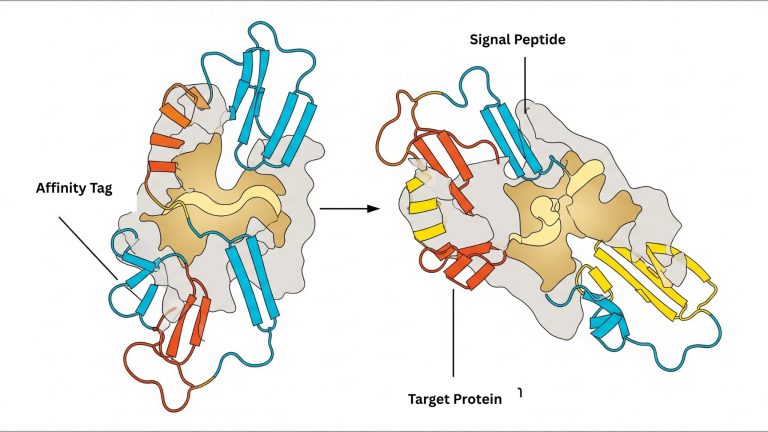
Recombinant proteins are produced by cells genetically modified to express genes from another source, a process called recombinant DNA technology. A gene encoding the desired protein is inserted into the DNA of the host and the host cell starts producing that protein as its own. High-quality recombinant proteins are produced through a complex process. You need to select the right host expression system, optimize culturing and induction conditions, and ensure purification.
Why High-Quality Matters
Therapeutic Rigor
When it comes to therapeutic rigor, high quality is essential for safe and effective treatment. Biosimilars development, for example, requires identical structure, function and immunogenicity in the target protein and the originator biologic.
Any deviation in the glycosylation, folding or purity of the protein can lead to:
- Reduced efficiency
- Altered pharmacokinetics
- Dangerous immune responses
It is essential to ensure purity and conformation of the Granulin (GRN) Recombinant Protein in GRN-based FTD therapies and similar treatments. It is important to ensure that the treatment targets the correct pathways.
Diagnostic Accuracy
Accuracy in diagnostic tests using recombinant proteins is crucial for detection, monitoring, and patient management. For example, ELISA (Enzyme-Linked Immunosorbent Assay) uses recombinant proteins to detect antibodies. Correctly identifying the presence or absence of a disease directly depends on the integrity of these protein components. Contaminated recombinant proteins can cause false positives, leading to potentially inappropriate treatment.
Research Reproducibility
Recombinant proteins are fundamental tools used in experiments such as biochemical assays, cell-based studies, complex structural analyses and more. Any deviation in the purity, folding and post-translational modifications can introduce noise which makes it difficult to replicate the findings.
For example, achieving high-resolution structures in X-ray crystallography or cryo-electron microscopy requires exceptional batch-to-batch consistency.
Any deviation in the protein’s folding can prevent crystallization or yield ambiguous data.
Industrial Performance
Food, agriculture, textiles, biofuels and many other sectors use functional proteins as biocatalysts to perform specific reactions with high precision. The performance of these proteins (enzymes) depends on their purity, proper folding, and stability.
For example, detergents use an industrial enzyme called proteases to break down stains. Similarly, food processing uses amylases for starch conversion. Improperly folded or impure enzymes can result in compromised catalytic activity. This, as a result, leads to reduced efficiency, increased costs and lower-quality end products.
The Foundational Trinity
Producing high-quality recombinant proteins is a complex process that includes the following three critical steps:
1. Vector Design
Vector design is crucial for efficient gene expression and high yields. The vector carries the gene encoding the protein. Vector design contains the following key elements:
Promoter
Promoter is the sequence that dictates the timing and strength of gene expression.
RBS (Ribosome binding site)
The RBS (Ribosome binding site) helps ribosomes in binding to the mRNA and initiating protein synthesis for translation in prokaryotic systems.
MCS (Multiple cloning site)
Unique restriction enzyme sites in this region allow convenient insertion of the gene.
Selection marker
A selection marker is an antibiotic resistance gene allowing for host cell selection.
ORI (Origin of replication)
This sequence enables independent replication of the vector within the host cell to ensure stable inheritance.
Fusion tags
Fusion tags, incorporated into the vector, encode small proteins or peptides to aid protein solubility, detection and purification.
Protease cleavage sites
A protease cleavage site is used to remove a fusion tag after purification.
These elements play a crucial role in gene expression, protein folding and downstream optimization.
2. Host Selection
Successful recombinant protein production heavily relies on the selection of the right host expression system. Each host system has unique advantages and disadvantages when it comes to cost, scalability, post-translational modifications and protein folding capabilities.
There are different types of cell systems including:
- Bacterial cell system
- Yeast cell system
- Insect cell host system
- Mammalian cell host system
Bacterial Cell System
In this system, the host organism provides the ideal environment for rapid growth and high protein yields at low cost. However, the host system lacks complex post-translational modifications. When it comes to complex eukaryotic proteins, this host system can lead to misfolding or formation of inclusion bodies.
Bacterial host systems such as E. coli are ideal for:
- Simple, non-glycosylated proteins
- High-yield production where post-translational modifications are not critical
Yeast Cell System
Yeast expression systems such as Saccharomyces cerevisiae and Pichia pastoris offer a cost-effective way to produce recombinant proteins. You can use these systems to perform some post-translational modifications (PTMs) which are crucial for the proper function of many eukaryotic proteins.
Pichia pastoris can achieve high cell densities which is suitable for large-scale production. You can use these systems to produce moderately complex proteins in significant quantities.
Insect Cell Systems
These systems utilize the Baculovirus-insect cell system. Insect host systems are ideal for complex eukaryotic proteins. You can perform specific post-translational modifications such as glycosylation and disulfide bond formation. These specific post-translational modifications are essential for correct folding and function of many proteins.
However, these systems are more expensive and slower to grow. Use them when you want to produce complex eukaryotic proteins that specifically require these particular PTMs.
Mammalian Cell Systems
Systems such as HEK293 and CHO cells are the best for therapeutic proteins. These systems provide human-like post-translational modifications. This enables intricate folding, and facilitates multi-subunit assembly. The result is the highest fidelity to native human proteins. Mammalian cell systems produce proteins where human-like modifications are critical for efficacy and safety.
However, there are some drawbacks including slow growth, technically demanding culture and high cost.
3. Purification
This step separates the protein from contaminants of the host cell to achieve high purity without sacrificing the protein’s structural integrity and biological activity.
The following are the common protein purification techniques:
Purification Technique |
Characteristics & Applications |
Principle of Separation |
Affinity Chromatography |
● First and most effective purification step
● High specificity ● Significant protein enrichment |
● Specific binding between a protein and a ligand on the stationary phase |
Ion Exchange Chromatography |
● Uses charged resins to bind oppositely charged proteins | ● Net charge based separation |
Size Exclusion Chromatography |
● Larger proteins elute first
● Best for polishing steps and removing aggregates |
● Hydrodynamic radius based separation |
Hydrophobic Interaction Chromatography |
● Strong binding at high salt concentrations
● Elute at lower salt concentrations |
● Hydrophobicity based separation |
Reversed-Phase Chromatography |
● Uses denaturing conditions
● Used for analytical purposes or peptide purification |
● Similar to HIC
● Uses more hydrophobic stationary phase |
