



While organisations focus on performance and growth, mental well-being at work doesn’t always get the attention it needs. Beyond physical surroundings, mental health at work is equally vital—yet too often, mental health stigma prevents open conversations and meaningful support. Myths like “mental health issues are a weakness” persist, causing many people to suffer silently.
As Kiran Mazumdar-Shaw, Trustee of The Live Love Laugh Foundation and Chairperson of Biocon Group, aptly puts it: “Mental health is an integral part of overall well-being, and organizations must recognize its impact on productivity, creativity, and resilience. A stressed and disengaged workforce hampers innovation and efficiency, ultimately affecting business outcomes and the broader economy.”
Her words highlight an urgent truth—addressing mental health isn’t just about compassion, it’s a critical lever for organizational performance. Creating psychologically safe, empathetic environments where employees feel supported is both a human and strategic imperative.
The Challenge: Burnout, Pressure, and the Weight of Stigma
According to the McKinsey Health Institute, a 2023 global survey—which included India—found only 57% of employees reported good holistic health, while around 20% experienced burnout symptoms. A more focused survey between Feb–Apr 2022, covering 15 countries including India, revealed nearly six in ten Asian employees showed signs of burnout, and 51% worked under high pressure.
Despite these alarming figures, stigma remains entrenched. McKinsey’s research shows that while 75% of employers acknowledge stigma in the workplace, far fewer have taken action—stigma reduction ranks last among prioritized initiatives.
Creating a mentally healthy workplace begins with understanding—gaining clear, data-backed insights into how employees are really doing. A comprehensive mental health survey offers organizations the opportunity to go beyond assumptions and uncover the actual drivers of stress, disengagement, and stigma.
The Live Love Laugh Foundation’s Corporate Mental Health and Well-being Program empowers organizations to place mental health at the heart of their workplace culture. Through data-driven insights, this employee mental health program helps companies assess the current state of employee mental health and well-being and uncover the underlying factors influencing it. With expert-led recommendations and a tailored implementation roadmap, the program supports organizations in launching impactful interventions and fostering long-term, sustainable cultural change.
An Evidence-Informed, Structured Engagement Strategy for Corporates
LiveLoveLaugh’s corporate engagement model is a stepwise, insight-driven approach designed to enable organizations to build mentally healthy workplaces. The blueprint outlines a comprehensive five-stage process:
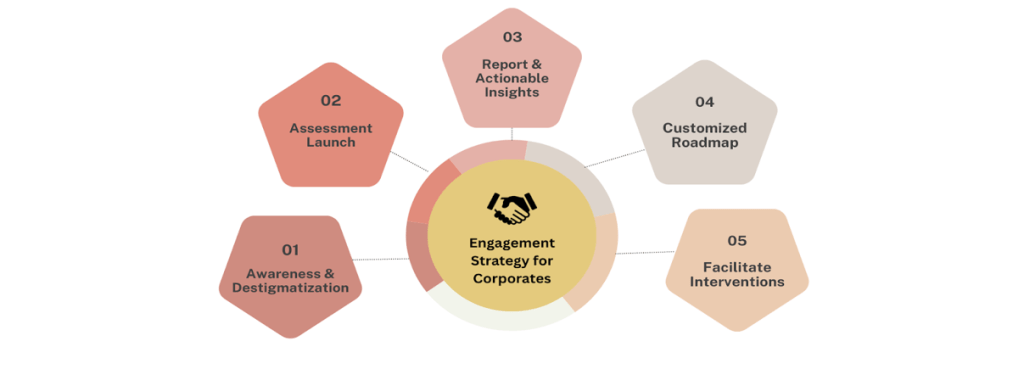
01. Awareness & Destigmatization
The program begins by fostering awareness and initiating open conversations around mental health. Through targeted communication, sensitization sessions, and storytelling, it helps reduce stigma and encourages a more supportive work environment.
02. Mental health survey Launch
An in-depth understanding of the workforce’s mental health landscape is essential. To support this, the program offers access to the Employee Mental Health and Well-being Assessment developed by the McKinsey Health Institute. This globally benchmarked diagnostic tool captures insights across multiple dimensions, including:
- Prevalence of burnout and chronic stress
- Levels of absenteeism and presenteeism
- Perceived psychological safety and inclusion
- Barriers to help-seeking
- Organisational drivers of mental health (e.g., workload, leadership behaviours, job control)
03. Report & Actionable Insights
Findings from the assessment are consolidated into a comprehensive report, highlighting key mental health indicators. These insights help identify priority areas for intervention and enable data-led decision-making by organizational leadership.
04. Customized Roadmap
Based on the insights generated, a tailored roadmap is co-developed in consultation with the organization. The roadmap outlines short- and long-term actions to build an inclusive, resilient, and mentally healthy workplace.
05. Facilitate Interventions
The final stage supports the implementation of interventions across different levels—ranging from leadership training and manager enablement to employee mental health programs and policy recommendations. All interventions are designed to be scalable, measurable, and contextually relevant.
Enabling Culture Change through Awareness and Action
Sustained progress in workplace mental health requires more than individual interventions. It demands a deliberate shift in organisational culture, supported by consistent action and leadership commitment.
- Visible Leadership Commitment
When organisational leaders model openness around mental health, it fosters an environment where vulnerability is seen as strength, not weakness.
- Continuous Awareness and Capacity Building
Structured workshops, sensitisation sessions, and evidence-led training play a key role in addressing stigma, building empathy, and improving mental health literacy across all levels of the workforce.
- Peer Support and Safe Dialogue Spaces
Creating safe, non-judgmental platforms for employees to connect and share their experiences helps strengthen psychological safety and a sense of belonging.
- Integrated, Accessible Support Systems
Mental health resources such as counselling, EAPs, and self-help tools must be actively promoted and normalised to ensure they are approachable and well-utilised.
- Ongoing Monitoring and Improvement
Embedding mental health assessments and feedback mechanisms into annual cycles allows organisations to track progress, evaluate impact, and refine their approach over time.
Creating workplaces where mental well-being is prioritised is no longer a choice—it is a necessity. When mental health is acknowledged, understood, and supported at every level of an organisation, it not only benefits individual employees but also strengthens the collective. Change begins with awareness, grows through action, and endures when empathy is woven into the very fabric of workplace culture.
